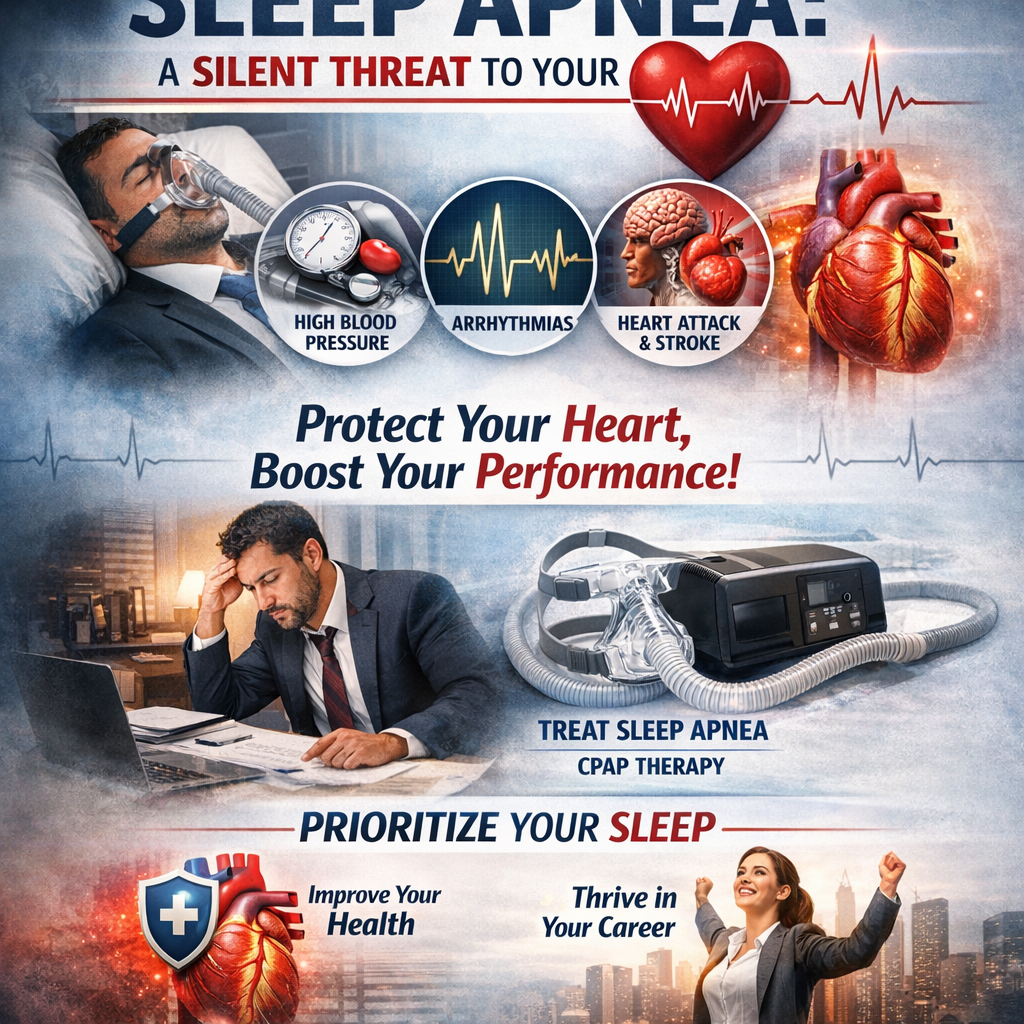
Breaking the Silence: How Sleep Apnea is the Hidden Catalyst for Cardiovascular Disease in High-Performing Professionals
Introduction
In today’s relentless fast-paced world, **high-performing professionals** are often hailed for their exceptional dedication and resilient work ethic. Yet beneath this polished veneer lies an insidious threat that many are unaware of: **sleep apnea**. This prevalent sleep disorder is marked by repeated interruptions in breathing during sleep. For those in demanding professions, the consequences can be profound, stretching far beyond just overtiredness.
**Sleep apnea** is commonly underestimated, often dismissed as nothing more than disruptive snoring. However, recent research has illuminated its role as a **silent catalyst for cardiovascular disease**, a condition that remains the leading cause of death globally. For high-performing individuals who are already susceptible to heart issues due to prolonged stress, irregular sleep, and sedentary lifestyles, the implications of untreated sleep apnea can be life-threatening.
Understanding the intricate link between sleep apnea and **cardiovascular health** is essential. As professionals ascend the career ladder, many embrace a lifestyle that undermines sleep, seeing it as time that is better spent working. Alarmingly, this sleep deprivation—coupled with untreated sleep apnea—places considerable stress on the body, creating a domino effect that significantly heightens cardiovascular risks. When the body cannot rest fully, blood pressure remains elevated, inflammation increases, and the risk of heart failure intensifies. Additionally, interrupted sleep affects the autonomic nervous system, which controls involuntary activities such as heart rate and blood pressure regulation.
Moreover, high-performing professionals may not recognize the symptoms of **sleep apnea**, such as chronic fatigue, morning headaches, or irritability, attributing them instead to high stress or workload. This misattribution can delay diagnosis and treatment, allowing the disorder to continue its course unchecked, silently eroding one’s cardiovascular health. Understanding the clear, though often overlooked, connections between sleep apnea and heart disease is pivotal not only for individual wellness but also for maintaining peak professional performance.
In this article, we delve into how sleep apnea goes unnoticed in high-performing professionals, its direct correlation with cardiovascular disease, and steps to mitigate this risk. By acknowledging and addressing sleep apnea, individuals can protect their heart health without sacrificing their professional commitments.
#### Features
Various studies underscore the pervasive impact of sleep apnea on heart health, revealing the condition’s linkage to cardiovascular disease. Research such as the **Sleep Heart Health Study** articulates the increased vulnerability to **hypertension**—a known precursor to heart disease. This extensive study involved monitoring over 6,000 participants and found a significant association between sleep apnea and heightened blood pressure levels. As high-performing professionals often encounter persistent stress, which can independently raise blood pressure, the compounded effect of untreated sleep apnea further exacerbates cardiovascular risks. [Study Link](https://www.nhlbi.nih.gov/science/sleep-heart-health-study-shhs)
Another compelling study from the **American Journal of Respiratory and Critical Care Medicine** highlights **obstructive sleep apnea (OSA)** as a critical factor in developing **arrhythmias**. The study shows that individuals with untreated OSA are more susceptible to **atrial fibrillation**, a condition characterized by an irregular heartbeat that can lead to stroke and heart failure. Given that high-performing professionals frequently engage in lifestyle habits that might prove deleterious to heart health—such as extended periods of immobility, poor dietary choices, and irregular sleep patterns—the added burden of sleep apnea becomes particularly alarming. [Study Link](https://www.atsjournals.org/doi/full/10.1164/ajrccm.161.3.9904079)
Moreover, a groundbreaking study revealed in the **European Respiratory Journal** focuses on the role of **oxidative stress** and **inflammation** as a consequence of sleep apnea. It illustrates how intermittent hypoxia—periods during which the body experiences low oxygen levels—due to sleep apnea can instigate systemic inflammation. This condition, in turn, serves as a catalyst for **atherosclerosis**, where arteries become hardened and narrowed, increasing the risk of heart attack and stroke. [Study Link](https://erj.ersjournals.com/content/early/2020/05/21/13993003.00938-2020)
Understanding these findings can compel professionals to take action. Therapies such as **Continuous Positive Airway Pressure (CPAP)** are shown to mitigate these adverse health impacts effectively. CPAP use not only improves sleep quality but also assists in stabilizing blood pressure and reducing the inflammatory response, as demonstrated in numerous clinical trials.
The connection between sleep apnea and cardiovascular disease is well-established, emphasizing the importance of public awareness and timely intervention. Bringing attention to sleep health can empower professionals to seek the necessary diagnostic procedures and embrace treatment options, safeguarding their cardiovascular wellness without compromising their careers.
Conclusion
As high-performing professionals strive for excellence in their fields, the unseen impact of sleep apnea on cardiovascular health cannot be ignored. By addressing this sleep disorder, individuals can thwart a potential catalyst for long-term health complications and enhance their professional performance. Recognizing the symptoms of sleep apnea and seeking appropriate diagnosis and treatment is vital. You are not just safeguarding your heart health but also setting a foundation where both professional success and personal well-being are symbiotic rather than mutually exclusive pursuits.
Informed choices concerning sleep can lead to healthier lives, enabling high-achievers to continue excelling without compromising their most valuable asset—their health. Therefore, breaking the silence surrounding sleep apnea is not just an individual endeavor; it is a collective necessity for a thriving workforce.
Concise Summary
Sleep apnea, often underestimated among high-performing professionals, can exacerbate cardiovascular risks including hypertension, arrhythmias, and atherosclerosis. Misattributing its symptoms to stress exacerbates these threats. Understanding its connection to heart disease is vital. Studies, including the Sleep Heart Health Study and findings in journals such as the American Journal of Respiratory and Critical Care Medicine, highlight this link. Effective treatments like CPAP can mitigate these effects. Raising awareness enables professionals to maintain both health and career performance, breaking the silence around this hidden health issue.

Dominic E. is a passionate filmmaker navigating the exciting intersection of art and science. By day, he delves into the complexities of the human body as a full-time medical writer, meticulously translating intricate medical concepts into accessible and engaging narratives. By night, he explores the boundless realm of cinematic storytelling, crafting narratives that evoke emotion and challenge perspectives.
Film Student and Full-time Medical Writer for ContentVendor.com