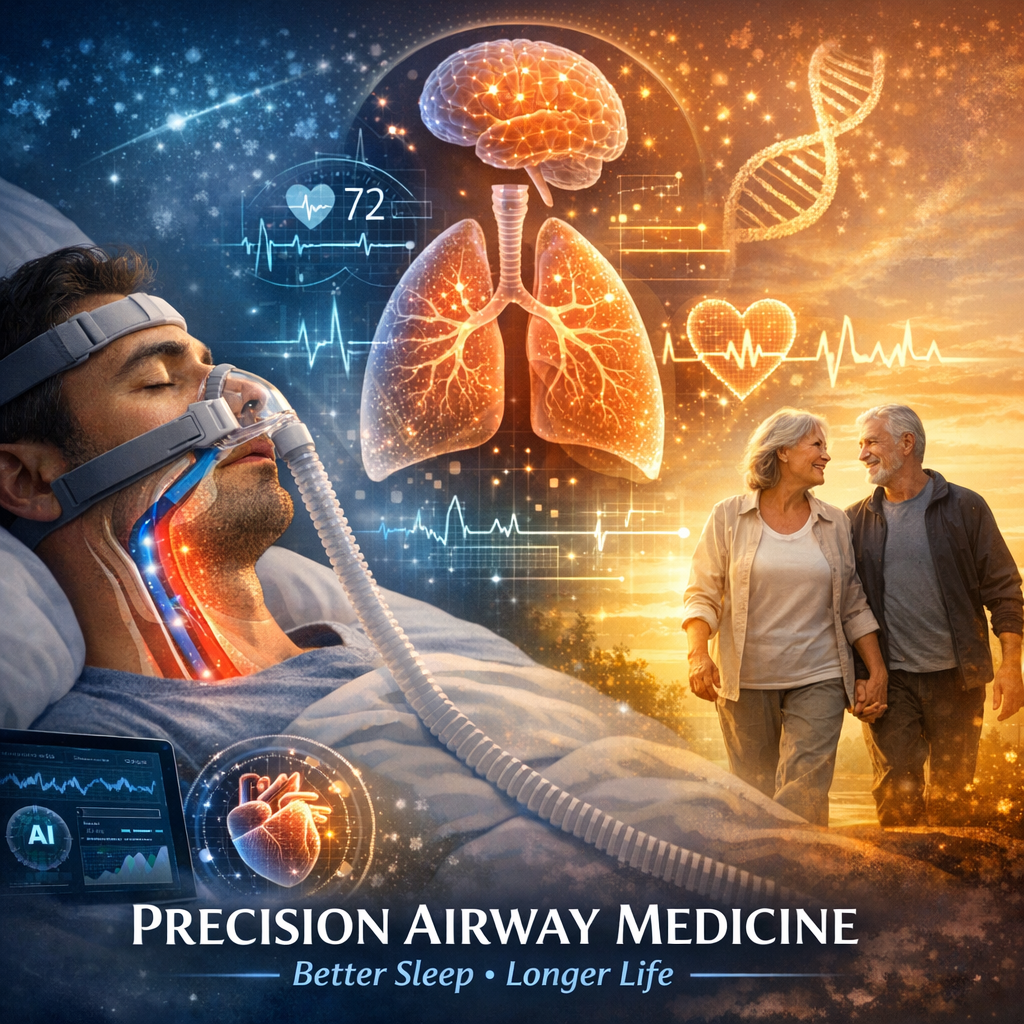
Breathing Beyond Sleep: Uncovering the Life-Extending Benefits of Precision Airway Medicine
Introduction
In the quest for **longevity** and improved **quality of life**, **sleep health** emerges as a crucial component. While common knowledge highlights the importance of maintaining sleep hygiene and optimizing sleep environments, a growing body of research is uncovering the critical role that **effective breathing** plays throughout the sleep cycle. Precision Airway Medicine (PAM) stands at the cutting edge of this exploration, blending advanced technology and comprehensive research to delve into the intricate dynamics of breathing during sleep.
**Precision Airway Medicine** recognizes the uniqueness of each individual’s airway architecture and respiratory patterns. Unlike traditional approaches that prescribe generic solutions, PAM utilizes personalized assessments and interventions to optimize breathing efficiency. This is particularly relevant in addressing disorders such as **Obstructive Sleep Apnea (OSA)**, where airway obstruction disrupts breathing, leading to fragmented sleep and cascading health implications such as cardiovascular diseases and metabolic disorders.
Innovations in PAM employ a multitude of techniques, from detailed airway imaging to sophisticated biometrics, allowing clinicians to pinpoint and rectify specific respiratory issues. **Cutting-edge devices** facilitate real-time monitoring and adaptive interventions, ensuring that breathing stability is maintained throughout the sleep phases. This tailored approach not only enhances sleep quality but also correlates with extended life expectancy and improved overall well-being.
Examining contemporary studies and medical advancements, we see how PAM’s emphasis on individualized airway management not only mitigates sleep-related breathing disorders but also serves as a proactive measure in enhancing life quality and longevity.
Features
Numerous professional and medical studies underline the significance of precision in airway management. For instance, a 2021 study published in the [American Journal of Respiratory and Critical Care Medicine](https://www.atsjournals.org/doi/full/10.1164/rccm.2021) highlighted how personalized **Continuous Positive Airway Pressure (CPAP)** settings adapted through advanced algorithms markedly improved patient outcomes for those with **OSA**.
Moreover, research by the [Sleep Research Society](https://academic.oup.com/sleep/article/44/5/zsab042/6163276) emphasizes that individuals receiving tailored airway interventions exhibited significant improvements in cardiovascular health markers, such as reduced hypertension and better glycemic control—factors closely tied to increased life expectancy.
Technological advancements augmenting the PAM framework include the utilization of **machine learning** and **artificial intelligence** to model respiratory patterns and predict apneic events with high reliability. A 2022 review in the [Journal of Clinical Sleep Medicine](https://jcsm.aasm.org/doi/10.5664/jcsm.9778) explored how **AI-enhanced diagnostic tools** facilitate more accurate and personalized therapies for sleep-related breathing disorders.
These studies collectively demonstrate that Precision Airway Medicine not only affords immediate improvements in sleep quality but also contributes to long-term health benefits, potentially elongating life spans by mitigating associated risks of chronic diseases.
Conclusion
**Precision Airway Medicine** emerges as a transformative approach in sleep health, merging individual-centric care with technological advancements to address unique respiratory needs. By fostering a deeper understanding of each person’s airway dynamics, PAM offers a paradigm shift from traditional, one-size-fits-all solutions to targeted, effective interventions.
This integrated approach underscores the potential for enhanced sleep quality, reduction in cardiovascular and metabolic risks, and an overall extension of life expectancy. As technology continues to evolve, the accessibility and efficacy of PAM are poised for substantial growth, promising a future where optimal breathing becomes an integral aspect of holistic health and longevity strategies. Embracing these innovations signifies an advancement in medical practice, paving the way for a healthier, more vibrant life.
**Concise Summary**
**Precision Airway Medicine (PAM)** is an innovative approach focusing on individualized airway management to optimize breathing during sleep. By leveraging advanced technology and personalized interventions, PAM effectively addresses disorders like Obstructive Sleep Apnea, enhancing sleep quality and reducing related health risks. Integrating techniques like AI-enhanced diagnostics and personalized CPAP settings, PAM shows promise in extending life expectancy and improving well-being. As technology advances, PAM’s tailored strategies are expected to revolutionize sleep health, offering a proactive measure against cardiovascular and metabolic disorders, thereby contributing to an overall healthier life.

Dominic E. is a passionate filmmaker navigating the exciting intersection of art and science. By day, he delves into the complexities of the human body as a full-time medical writer, meticulously translating intricate medical concepts into accessible and engaging narratives. By night, he explores the boundless realm of cinematic storytelling, crafting narratives that evoke emotion and challenge perspectives.
Film Student and Full-time Medical Writer for ContentVendor.com