The Overlooked Respiratory Component: How Mouth Breathing Could Be the Hidden Barrier to Your Healthspan
Introduction
**Breathing** is a vital physiological process that often goes unnoticed in our daily lives. Most of us pay little attention to whether we’re inhaling and exhaling through our noses or mouths, yet the mechanism of our breath can significantly impact our overall **health**. **Mouth breathing**, despite being a common phenomenon, is often overlooked as a potential barrier to optimal **wellness** and **longevity**. As we dive deeper into the understanding of **healthspan**—the period of life spent in good health, free from chronic diseases and serious illnesses—it’s crucial to examine the implications of how we breathe.
**Mouth breathing**, whether habitual or situational, is more than just a simple quirk; it can be a sign of underlying health issues and can lead to a cascade of negative health effects. From impacting **dental health** to influencing **sleep quality** and even **cognitive function**, the effects of **mouth breathing** are far-reaching. This seemingly innocuous habit is particularly concerning when considering its cumulative impact over time, which could potentially shorten one’s **healthspan**.
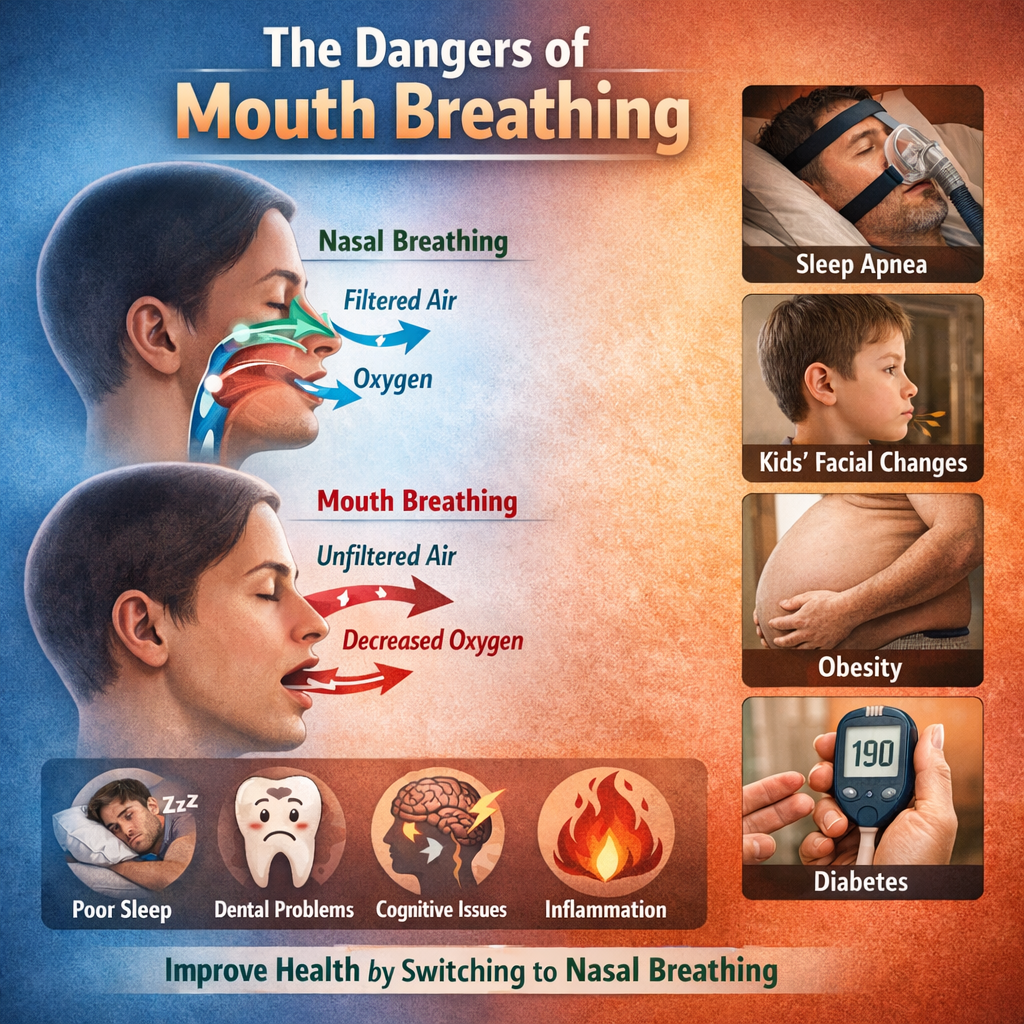
A proper understanding of **nasal versus mouth breathing** starts with the anatomy and function. The **nose** is equipped with the ability to filter, humidify, and regulate the temperature of the air we breathe. It produces **nitric oxide**, a compound instrumental in expanding blood vessels, improving **oxygen circulation**, and providing various antibacterial benefits. In contrast, **mouth breathing** bypasses these vital processes, leading to a drier airway environment prone to infections and inflammation.
The consequences of chronic **mouth breathing** are particularly evident during sleep. It can contribute to **sleep-disordered breathing** conditions such as **snoring** and **obstructive sleep apnea (OSA)**, both of which can lead to fragmented sleep and reduced oxygenation throughout the night. Moreover, poor sleep quality is closely linked to numerous health issues, including **cardiovascular disease**, **diabetes**, **obesity**, and a weakened **immune system**—all critical factors in defining one’s **healthspan**.
For children, habitual **mouth breathing** can adversely affect **facial development**, **dental alignment**, and **speech**. It may also lead to behavioral issues often misdiagnosed as **attention-deficit disorders** due to the fatigue and cognitive impairments associated with poor sleep quality. Understanding the long-term ramifications of **mouth breathing** is essential for parents, educators, and healthcare providers alike.
Recognizing and addressing **mouth breathing** early can create a significant impact on one’s quality and length of life. With growing awareness and the correct interventions, the barriers imposed by this habit can be effectively managed, leading to improved respiratory health, sleep, and an extended period of good health.
Features
Scientific research offers invaluable insights into the impacts of **mouth breathing** on **healthspan**, demonstrating that this is not just an idle concern but one requiring attention. A pivotal study published in the Journal of Clinical Sleep Medicine (Carlini et al., 2015) highlights the impact of **mouth breathing** on **obstructive sleep apnea severity**. The study found a significant correlation between habitual **mouth breathing** and increased episodes of **apnea** during sleep, leading to severe oxygen desaturation and fragmented sleep patterns. The implications of this are profound, given the well-established connections between **sleep apnea** and systemic health conditions such as **hypertension**, **cardiovascular disease**, and **metabolic syndrome**.
Another aspect of scientific inquiry into **mouth breathing** focuses on pediatric health. Research by Jefferson (2010) in the journal “General Dentistry” points to how **mouth breathing** affects the **dental** and **facial development** in children. Chronic **mouth breathing** was shown to lead to **malocclusions**, high palatal arches, and elongated facial structures. Such changes are not purely cosmetic; they have functional ramifications affecting airway resistance and nasal breathing capacity, perpetuating a cycle of disadvantaged respiration.
The neurological impacts of **mouth breathing** have also drawn considerable interest. A study in the International Journal of Pediatric Otorhinolaryngology (Gomes et al., 2014) assessed cognitive performance among children with **mouth breathing** habits. The findings indicated lower scores in attention and executive function tests compared to their **nasal-breathing** counterparts. This observation aligns with theories that compromised sleep and lower oxygenation levels can impact brain function.
Moreover, J. M. Briefer’s 2019 work in “Frontiers in Public Health” provides a broader perspective on **mouth breathing** implications. The research underscores how this habit can exacerbate systemic inflammation due to the dry oral environment and disrupted sleep, factors that contribute to chronic conditions such as **Type 2 diabetes** and **obesity**.
These scientific endeavors unequivocally stress the importance of recognizing **mouth breathing** not just as a nasal or oral concern but a multi-system issue affecting overall health and longevity. Addressing **mouth breathing** through interventions like **myofunctional therapy**, **orthodontic treatment**, or even simple habit modification can thus play a pivotal role in enhancing one’s **healthspan**.
Conclusion
**Mouth breathing** is more than an innocuous habit. It’s a subtle yet noteworthy barrier to our **healthspan**, affecting everything from airway health and **dental development** to sleep quality and **cognitive function**. The scientific and medical communities increasingly recognize the necessity of addressing this overlooked respiratory component.
By fostering awareness and promoting preventative and corrective strategies, we can mitigate the negative impacts of **mouth breathing**. Practices like encouraging children and adults to breathe through their noses; seeking medical advice for airway obstructions; and employing therapies designed to realign oral function are steps toward reclaiming a healthy respiratory pattern.
In essence, optimizing how we breathe can contribute significantly to an improved quality of life and an extended **healthspan**. With conscious effort and appropriate interventions, overcoming the hidden barrier of **mouth breathing** is an achievable goal, heralding a healthier future.
**References**
– Carlini, R., Corso, R. J. 2015. “Mouth Breathing: Importance and Implications for Dental Health.” Journal of Clinical Sleep Medicine. Available at: https://jcsm.aasm.org
– Jefferson, Y. 2010. “Mouth breathing: Adverse effects on facial growth, health, academics, and behavior.” General Dentistry.
– Gomes, A. C., Trezza, P., Murad, L., Anselmo-Lima, W. 2014. “Mouth breathing and its relationship to sleep disorders and attention in children.” International Journal of Pediatric Otorhinolaryngology. Available at: https://www.jped.org.br
– Briefer, J. M. 2019. “Mouth Breathing: A Potential Health Concern with Systemic Implications.” Frontiers in Public Health. Available at: https://www.frontiersin.org
**Concise Summary**
Mouth breathing is often overlooked but has significant impacts on healthspan, affecting dental health, sleep quality, and cognitive function. This habit disrupts nasal breathing benefits, leading to health issues like sleep apnea, systemic inflammation, and developmental concerns in children. Addressing mouth breathing with interventions such as myofunctional therapy and habit modification can significantly enhance one’s quality of life and healthspan. Increased awareness and corrective actions offer a path to improved respiratory health and longevity.

Dominic E. is a passionate filmmaker navigating the exciting intersection of art and science. By day, he delves into the complexities of the human body as a full-time medical writer, meticulously translating intricate medical concepts into accessible and engaging narratives. By night, he explores the boundless realm of cinematic storytelling, crafting narratives that evoke emotion and challenge perspectives.
Film Student and Full-time Medical Writer for ContentVendor.com