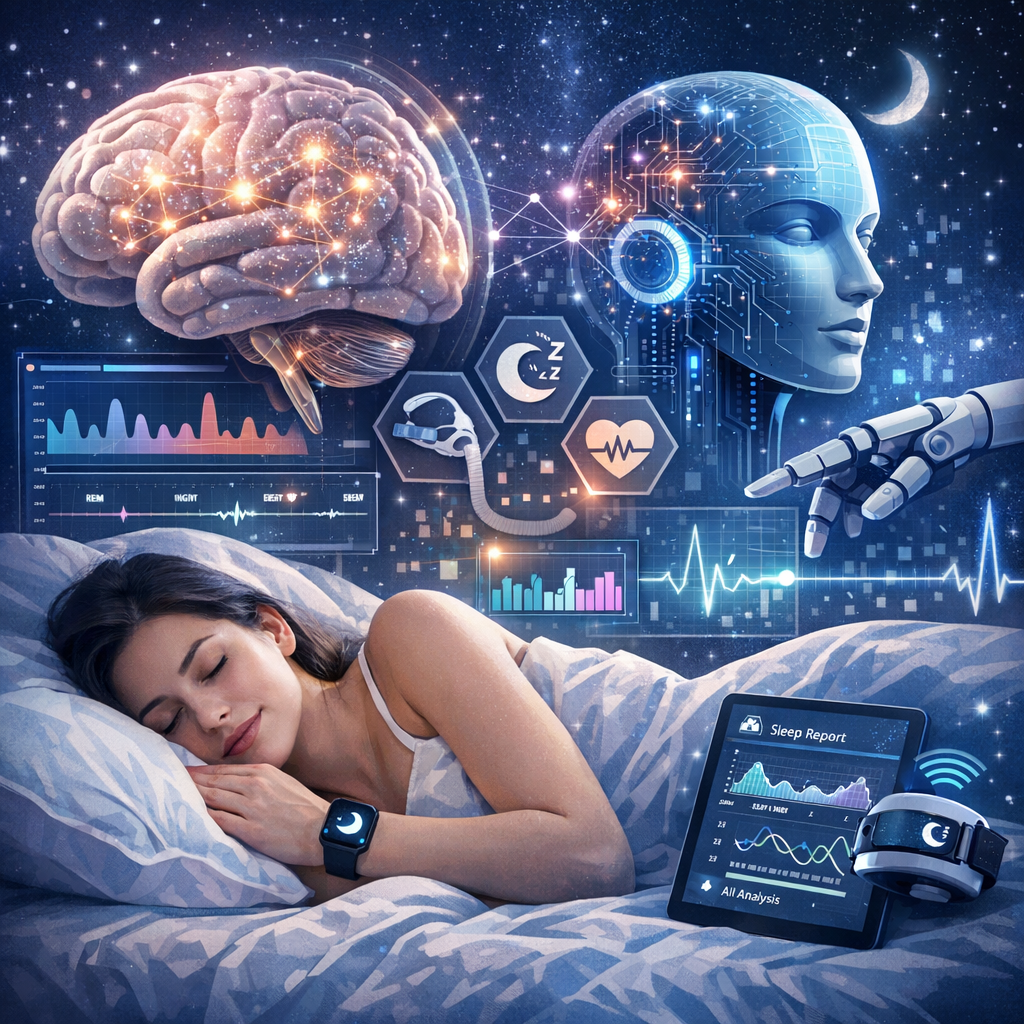
Unlocking Hidden Performance: The Role of AI in Diagnosing Sleep Disorders and Boosting Cognitive Function
In today’s rapidly advancing society, the critical role of **quality sleep** is often overlooked, despite its significant impact on **cognitive function**, emotional well-being, and overall health. The complexities of **sleep disorders**, affecting millions worldwide, require innovative solutions for accurate diagnosis and effective treatment. Enter **Artificial Intelligence (AI)**, a revolutionary technology propelling our understanding and management of sleep disorders into new realms.
The application of **AI in sleep medicine** is particularly promising, capturing substantial attention in recent years. Diagnosing sleep disorders is challenging because of subtle, overlapping symptoms. Traditional methods like **polysomnography** are expensive and limited in capturing day-to-day variations in sleep. Here, AI acts as a transformative force. By analyzing large-scale data, AI can identify patterns indicative of sleep disorders that might otherwise be missed by conventional means.
Moreover, AI’s influence extends beyond diagnosis to addressing cognitive decline linked to poor sleep quality—a key factor in **learning, memory consolidation**, and decision-making. Disruptions commonly seen in conditions like **insomnia** and **sleep apnea** are now addressed through AI-driven tools offering personalized interventions. These interventions might include cognitive exercises or behavioral strategies tailored to individual needs, promoting cognitive health.
The rise of **wearable technology** complements this AI evolution. Devices like **smartwatches** with sleep-tracking capabilities collect valuable data, which AI analyses to provide meaningful feedback on sleep patterns. This integration bridges the gap between clinical and everyday environments, empowering individuals to take control of their sleep health.
AI also significantly enhances the feedback loop in **sleep research**. By sorting through vast datasets, AI identifies trends and insights that contribute to an evolving understanding of sleep science. The continuous learning capability of AI ensures adaptiveness to new findings, paving the way for groundbreaking therapeutic strategies.
Features of AI in Sleep Research and Cognitive Enhancement
Several studies underscore AI’s potential in **sleep diagnostics** and **cognitive enhancement**. An important study published in [*Nature and Science of Sleep*](https://www.nature.com/nature-and-science-of-sleep/) demonstrated AI’s ability to interpret polysomnography recordings with precision akin to sleep specialists. This efficiency significantly reduces the time required for data interpretation, expediting diagnosis and intervention processes.
AI’s capacity for personalized management of sleep disorders is exemplified by research from the [University of Pennsylvania](https://www.upenn.edu/research/sleep-research). Their studies highlight AI algorithms capable of identifying nuanced sleep architecture variations, thereby customizing **cognitive behavioral therapy (CBT)** for insomnia more effectively than traditional methods.
Regarding cognitive enhancement, the [University of California](https://www.universityofcalifornia.edu/newsroom/ai-sleep-studies) utilized AI-driven strategies to mitigate cognitive effects of sleep deprivation in shift workers. This research highlighted significant cognitive performance improvement in participants using AI-personalized interventions.
AI’s benefits are not confined to lab settings. Wearable technology employing AI provides real-world solutions. Research in the [*Journal of Clinical Sleep Medicine*](https://jcsm.aasm.org/) revealed consumer wearables reported sleep patterns with high accuracy, further validating their utility for ongoing sleep monitoring.
These studies illuminate AI’s pivotal role in understanding and improving sleep health. Advancements in AI-driven analytics sharpen diagnostic acumen and offer novel pathways for cognitive rehabilitation in sleep-impaired individuals.
Conclusion
AI’s role in diagnosing sleep disorders and enhancing cognitive function is revolutionary. By leveraging AI’s analytical power, healthcare professionals deliver more accurate, efficient, and personalized care for those affected by sleep disturbances. AI-enhanced diagnostic tools and consumer technologies empower individuals to take proactive steps towards better sleep hygiene and cognitive function.
AI’s dynamic ability for continuous learning keeps it at the forefront of sleep science developments. As AI-driven innovations in sleep medicine continue to evolve, we are on the verge of a healthcare revolution promising improved cognitive health and quality of life. Embracing these advancements redefines sleep health management, unlocking pathways to cognitive excellence.
**Summary:**
In the fast-paced world, **AI** is revolutionizing the understanding and diagnosis of **sleep disorders**, significantly improving **cognitive health**. AI efficiently interprets vast data, recognizing patterns in sleep-related issues often missed by traditional methods like polysomnography. Alongside wearable technology, AI personalizes interventions for cognitive enhancement and sleep improvement, empowering individuals to manage their health. Studies highlight AI’s precision and speed in identifying sleep disorder symptoms and customizing treatment strategies, showcasing its transformative impact on healthcare. As AI continues evolving in sleep research, it holds the potential to revolutionize sleep health management, ensuring better personal and clinical outcomes.

Dominic E. is a passionate filmmaker navigating the exciting intersection of art and science. By day, he delves into the complexities of the human body as a full-time medical writer, meticulously translating intricate medical concepts into accessible and engaging narratives. By night, he explores the boundless realm of cinematic storytelling, crafting narratives that evoke emotion and challenge perspectives.
Film Student and Full-time Medical Writer for ContentVendor.com