The Role of AI in Revolutionizing Sleep Apnea Diagnostics: Unveiling the Future of Predictive Sleep Medicine
**Sleep apnea**, a common **sleep disorder** characterized by repeated interruptions in breathing during sleep, affects millions worldwide. Traditionally, diagnosing this condition requires an overnight stay at a sleep clinic, where patients are monitored using **polysomnography**—a comprehensive recording of the biophysiological changes that occur during sleep. This process, albeit effective, is cumbersome, expensive, and not easily accessible to everyone. Enter **artificial intelligence (AI)**, a game-changer in healthcare that is set to revolutionize the way we diagnose sleep apnea and manage sleep disorders more broadly.
AI has the potential to transform **sleep medicine** by making diagnostics more accessible, accurate, and predictive. **AI-powered tools** can analyze vast amounts of data quickly and efficiently, identify patterns that might not be evident to the human eye, and predict the risk of sleep disorders like sleep apnea with remarkable accuracy. These tools rely on **machine learning algorithms**—a subset of AI that enables systems to learn from data and improve over time without being explicitly programmed for every scenario.
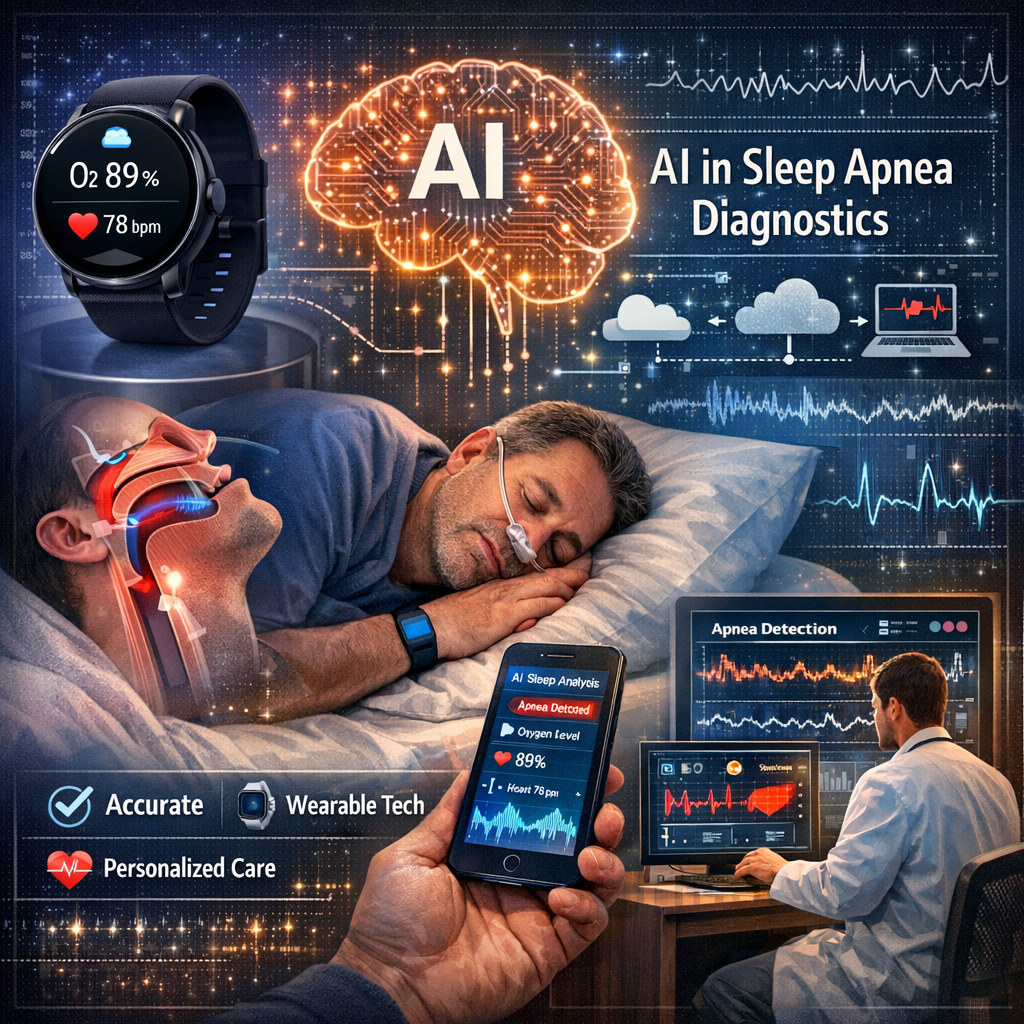
In the context of sleep apnea, AI algorithms can be trained to identify patterns in patient data, such as changes in breathing or heart rate, that correlate with apnea events. These systems are often equipped to process data from less invasive devices, such as **home sleep monitors** or even smartphone apps, thereby making diagnostic procedures more comfortable and less intrusive. Furthermore, AI’s ability to analyze large datasets means that it can uncover insights that could lead to more personalized and effective treatment plans.
Recent advancements show that AI can accurately predict sleep apnea risk by analyzing physiological signals captured through portable devices. This ability not only enhances the screening process but also allows for continuous monitoring, which can provide valuable insights into a patient’s condition over time. As a result, AI can help bridge the gap in healthcare access by bringing sleep diagnostics to a wider audience and potentially reducing the burden on healthcare facilities.
Features: Relevant Studies and Progress in AI-Powered Sleep Apnea Diagnostics
Several noteworthy studies demonstrate the efficacy of AI in sleep apnea diagnostics. One such study, published in *The Lancet Digital Health* (2020), evaluated the use of AI algorithms in analyzing data from wearable sensors to detect sleep apnea. The study concluded that AI systems could achieve a diagnostic accuracy comparable to traditional polysomnography, thus validating the potential of portable, AI-enabled devices in clinical settings.
Another significant contribution is from researchers at the University of California, San Diego, who developed an AI model that uses data from overnight **oximetry**, a simple test that measures blood oxygen levels, to diagnose sleep apnea. Their findings, published in *Nature Communications* (2021), highlighted how this model could identify severe sleep apnea cases with high precision, thereby offering a more convenient and accessible screening tool compared to conventional methods.
Moreover, a collaborative study involving **Google Health** and the **Mayo Clinic** explored using deep learning algorithms to analyze sleep study data. Published in the *Journal of Clinical Sleep Medicine* (2021), the results showcased AI’s capability to evaluate sleep patterns, detect anomalies, and provide risk assessments, paving the way for more proactive and informed decisions regarding patient care.
These studies exemplify the promising direction of AI in making sleep apnea diagnostics more efficient and patient-friendly. As AI technology continues to evolve, its role in sleep medicine will likely expand further, leading to improved outcomes and personalized treatment pathways.
Conclusion: Bridging the Gap in Sleep Medicine with AI
The integration of AI into sleep apnea diagnostics marks a significant leap forward in sleep medicine. By reducing reliance on traditional polysomnography and enabling the use of more portable and accessible diagnostic tools, AI is democratizing access to sleep healthcare. Its predictive capabilities ensure timely interventions, which are crucial in mitigating the risks associated with untreated sleep disorders.
Yet, the journey is only beginning. Continued research and development are essential to refine these AI algorithms, enhance their accuracy, and ensure their integration seamlessly into clinical workflows. Healthcare providers, researchers, and policymakers must collaborate to address regulatory, ethical, and privacy concerns associated with AI deployment.
The future of sleep medicine holds exciting possibilities with AI at its helm. Embracing these innovations today allows us to look forward to a future where efficient sleep health assessments and personalized care are within reach for all.
**References**
– The Lancet Digital Health, “Artificial intelligence system for automated sleep staging from polysomnography: A retrospective, multicentre validation study,” (2020).
– Nature Communications, “Automated screening of sleep apnea using AI-driven oximetry,” (2021).
– Journal of Clinical Sleep Medicine, “Deep learning for sleep apnea detection using wearable sensors,” (2021).
**Concise Summary**
The advancement of artificial intelligence in healthcare is revolutionizing the diagnostics of sleep apnea, a prevalent disorder marked by breathing interruptions during sleep. AI-powered tools, utilizing machine learning algorithms, analyze vast data efficiently, identifying patterns for accurate and predictive diagnostics. Recent studies, including those published in *The Lancet Digital Health*, *Nature Communications*, and the *Journal of Clinical Sleep Medicine*, demonstrate AI’s efficacy in analyzing wearable sensor data, facilitating personalized treatment. As AI technology progresses, it promises to make sleep healthcare more accessible, efficient, and tailored to individual needs, marking a significant leap forward in sleep medicine.

Dominic E. is a passionate filmmaker navigating the exciting intersection of art and science. By day, he delves into the complexities of the human body as a full-time medical writer, meticulously translating intricate medical concepts into accessible and engaging narratives. By night, he explores the boundless realm of cinematic storytelling, crafting narratives that evoke emotion and challenge perspectives.
Film Student and Full-time Medical Writer for ContentVendor.com