The “Silent Hypoxia” in Sleep: Why Your Oxygen Levels Aren’t What They Seem and How It’s Impacting Your Health
Introduction
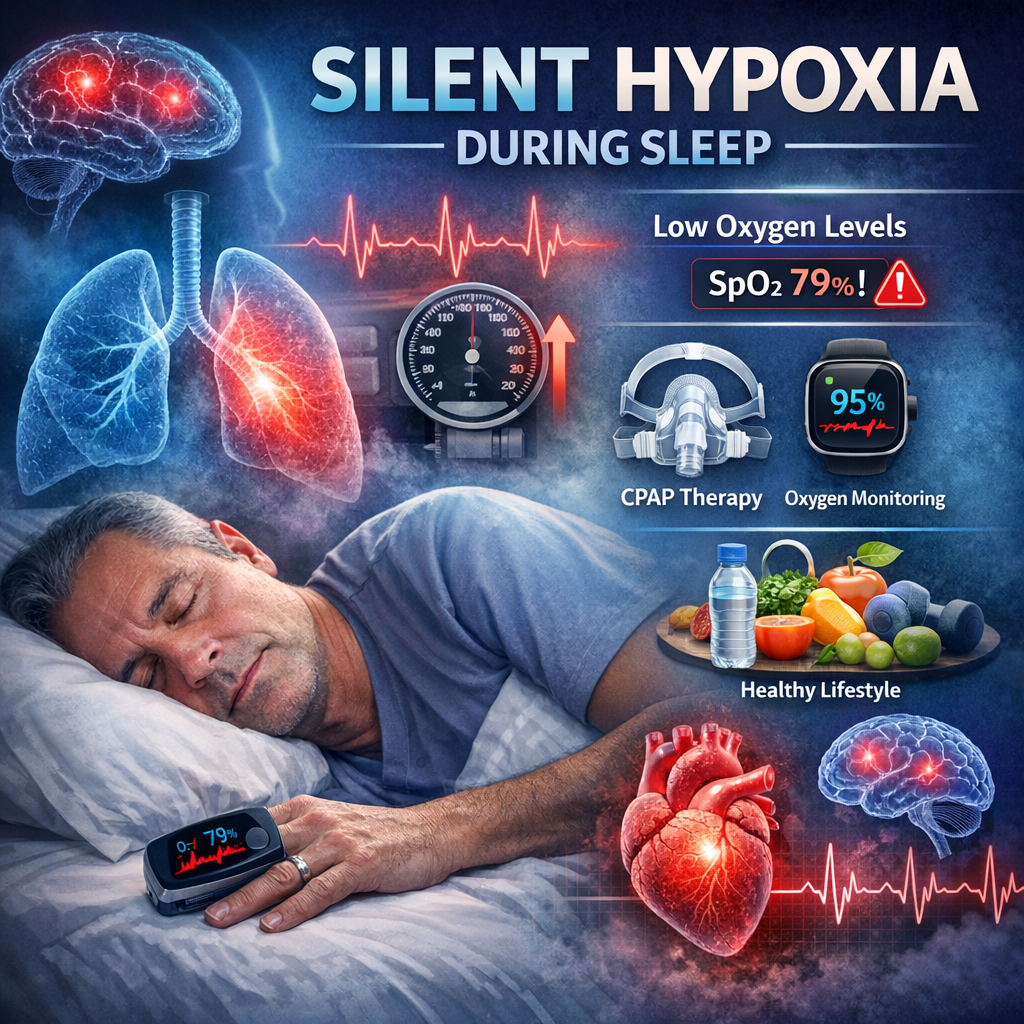
Sleep is a vital component of holistic health, essential for rest, rejuvenation, and repair. While we often equate quality sleep with the hours spent asleep, **oxygen levels** also play a vital role. **Silent hypoxia**, a condition where blood **oxygen levels** drop without symptoms, is a significant yet often unrecognized concern. Unlike **sleep apnea**, which causes noticeable breathing interruptions, silent hypoxia doesn’t trigger alarms like snoring or abrupt awakenings, leaving individuals feeling tired despite a full night’s sleep. This condition can worsen health issues like **COPD** or **heart failure** and also impacts seemingly healthy individuals. Understanding silent hypoxia involves examining the physiological mechanics of the lungs during sleep and the nuances of sleep stages. During **REM sleep**, muscles relax, potentially leading to reduced airway functions and nighttime hypoxia.
Recognizing and addressing silent hypoxia not only helps individuals feel refreshed upon waking but is also vital in preventing severe health complications later on.
Features
Scientific inquiry and **technological advancements** have highlighted the stealthy nature of silent hypoxia and its health implications. A significant study from the [American Journal of Respiratory and Critical Care Medicine](https://www.atsjournals.org/doi/full/10.1164/rccm.201908-1548OC) found that repeated minor episodes of nocturnal oxygen deprivation could raise **blood pressure** and induce **vascular inflammation**, precursors to **cardiovascular diseases**. Furthermore, research from the [University of Michigan](https://content.iospress.com/articles/journal-of-alzheimers-disease/jad191248) suggested that sleep-related hypoxia might contribute to cognitive decline by causing micro damages in the brain, affecting **neuroplasticity**. Home sleep monitors have evolved, making detection of sleep hypoxia more feasible. Devices with pulse oximetry sensors offer a non-invasive way to monitor **nocturnal oxygen saturation**. Recent innovations in wearable technology, as shown in a [Journal of Clinical Sleep Medicine](https://jcsm.aasm.org/doi/full/10.5664/jcsm.8768) study, show these devices’ precision in identifying low oxygen events, allowing for intervention before serious health issues develop. Interventions like lifestyle changes, positional therapy, and in some cases, using **Continuous Positive Airway Pressure (CPAP)** machines, have shown promise in mitigating sleep-related hypoxia, as evidenced by a review in the [Journal of Thoracic Disease](https://jtd.amegroups.com/article/view/37688/html).
Conclusion
Understanding silent hypoxia can be transformative for sleep health awareness. This condition, subtle but significant, affects health and wellbeing, making it a crucial focus for those striving for optimal sleep hygiene. Awareness and early detection, combined with lifestyle adjustments and medical interventions when needed, are key. By utilizing technology to monitor not just sleep duration but quality—through metrics like oxygen saturation—patients and clinicians can holistically address sleep-related issues. Tackling silent hypoxia is not just about a restful night’s sleep but preventing health problems linked to poor oxygenation. As sleep science advances, integrating these insights into daily routines will bridge the gap between sleep quantity and quality, ensuring the silent theft of oxygen doesn’t compromise our long-term health.
**Concise Summary:**
**Silent hypoxia** is a condition where blood **oxygen levels** drop without obvious symptoms, significantly affecting sleep quality and overall health. Unlike **sleep apnea**, it produces no warning signs like snoring. This issue doesn’t only impact those with pre-existing conditions like **COPD** or **heart failure**, but also healthy individuals. Monitoring with **wearable technology** and interventions like **CPAP** are crucial for early detection and management, preventing severe health complications. Addressing silent hypoxia ensures better sleep quality and long-term health by closing the gap between sleep duration and true restorative rest.

Dominic E. is a passionate filmmaker navigating the exciting intersection of art and science. By day, he delves into the complexities of the human body as a full-time medical writer, meticulously translating intricate medical concepts into accessible and engaging narratives. By night, he explores the boundless realm of cinematic storytelling, crafting narratives that evoke emotion and challenge perspectives.
Film Student and Full-time Medical Writer for ContentVendor.com