Unlocking the Hidden Dangers: How Untreated Sleep Disorders Secretly Devastate Workplace Productivity and Employee Well-Being
In today’s fast-paced world, **sleep** is often sacrificed on the altar of **productivity**. However, this sacrifice has profound implications that few seem to recognize. Sleep disorders, which affect a substantial portion of the global population, are more than just an individual **health issue**—they silently undermine workplace productivity and employee well-being. The importance of addressing sleep disorders cannot be overstated, as untreated sleep issues can lead to a cascade of negative outcomes both for individuals and organizations.
We live in an era where the lines between **work and personal life** are increasingly blurred. The rise of **remote working**, **digital connectivity**, and constant demands for high performance put unprecedented stress on employees. While this shift has its advantages, it also contributes to a **sleep-deprived workforce**. According to the [**Centers for Disease Control and Prevention (CDC)**](https://www.cdc.gov/sleep/data_statistics.html), insufficient sleep is a public health problem, with around one-third of adults not getting enough sleep on a regular basis. Sleep disorders like **insomnia**, **sleep apnea**, and **restless leg syndrome** are often left untreated, leading to chronic sleep deprivation and other health issues.
The **cost of sleep-related issues** is staggering. The [**American Academy of Sleep Medicine**](https://aasm.org/) has reported that the U.S. economy loses approximately $411 billion annually due to insufficient sleep. This loss is not only due to reduced productivity but also from increased **absenteeism** and **healthcare costs**. Employers may unknowingly perpetuate this cycle by failing to recognize the importance of sleep health in their **wellness programs**. Additionally, the stigma associated with sleep disorders often prevents employees from seeking help, exacerbating the issue over time.
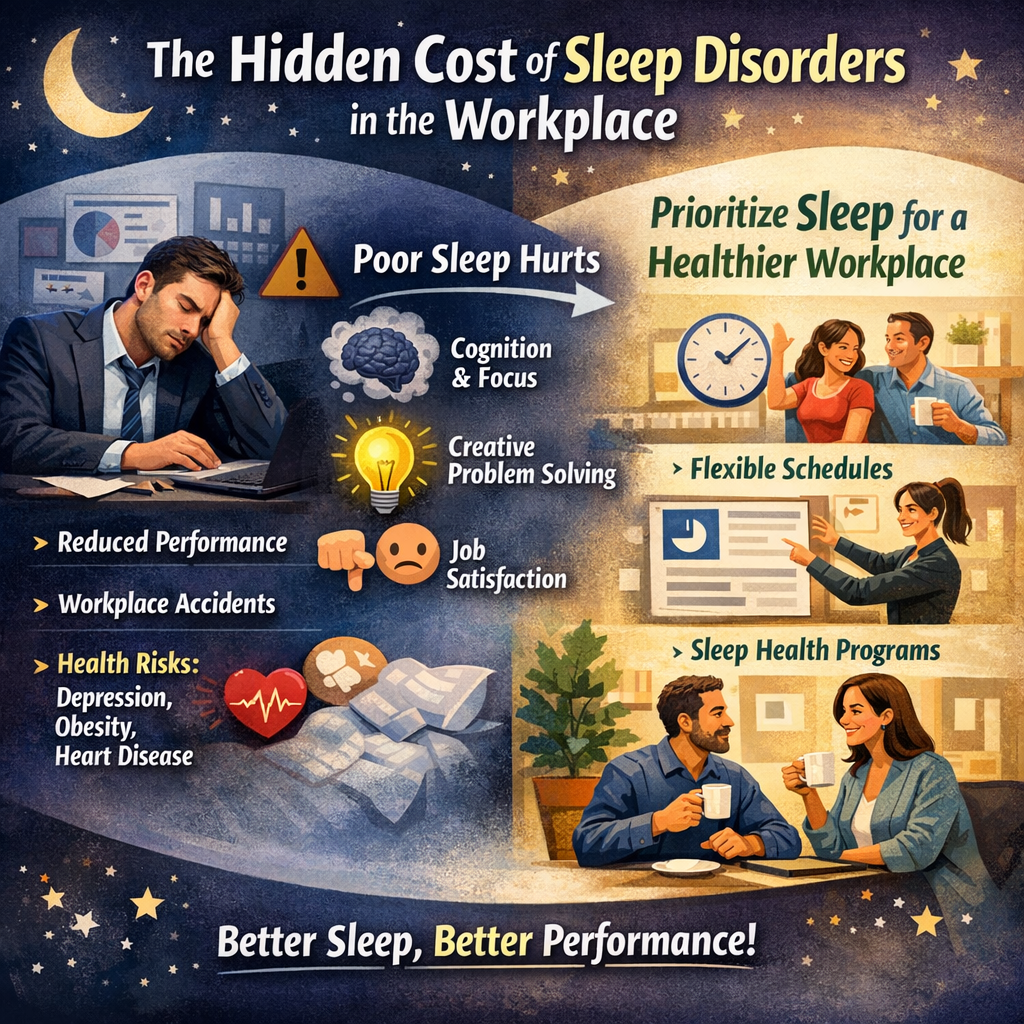
Beyond economic costs, the **human cost** is even more alarming. Sleep disorders can lead to a host of physical and mental health challenges, including **cognitive decline**, **depression**, **anxiety**, and decreased immune function. Chronic sleep deprivation has been linked to increased risk of chronic conditions such as **obesity**, **diabetes**, and **cardiovascular disease**. For employees, this means a reduced quality of life, decreased job satisfaction, and an increased risk of workplace accidents. For employers, it translates into a workforce that is less engaged, less creative, and more prone to errors.
Features
Over the years, several professional and medical studies have highlighted the profound impact sleep disorders have on workplace productivity and employee well-being. A study published in the [**Journal of Occupational and Environmental Medicine**](https://journals.lww.com/joem/pages/default.aspx) found that insomnia results in a significant loss of productivity at work, estimating an annual cost of $3,156 per employee in the United States due to reduced performance and productivity issues. This study illustrates the substantial economic burden that individual sleep disorders can have on organizations.
The [**Harvard Medical School’s Division of Sleep Medicine**](https://sleep.med.harvard.edu/) has extensively researched the links between sleep and cognitive function. Their studies indicate that sleep is crucial for memory consolidation, problem-solving skills, and creative thinking. Employees suffering from untreated sleep disorders are at a distinct disadvantage when it comes to performing tasks that require these skills, thereby impacting overall workplace productivity.
Similarly, a study published in the [**Journal of Clinical Sleep Medicine**](https://jcsm.aasm.org/) underscores the severity of sleep apnea, a common but often overlooked sleep disorder. The study links untreated sleep apnea to increased risk of workplace accidents and decreased job performance due to excessive daytime sleepiness and impaired alertness. These findings have prompted an increased focus on workplace policies that support sleep health initiatives, such as flexible work schedules and sleep disorder screenings.
Furthermore, research conducted by the [**National Sleep Foundation**](https://www.sleepfoundation.org/) has shown that improving sleep health can lead to significant improvements in mental health and overall well-being. According to their findings, interventions aimed at enhancing sleep quality not only improve job satisfaction and engagement but also reduce the incidence of workplace burnout and stress-related illnesses.
These studies collectively advocate for greater awareness and proactive management of sleep health in workplace settings. By recognizing the hidden dangers of untreated sleep disorders, both employers and employees can take steps toward creating more productive and healthier work environments. Incorporating sleep education and screenings as part of employee wellness programs can make a substantial difference in enhancing workplace productivity and fostering a culture of well-being.
Conclusion
**Sleep disorders** present a significant, yet often invisible, threat to workplace productivity and employee well-being. Addressing these issues requires a combined effort from both **employers and employees**. Employers can lead the change by implementing sleep health initiatives, offering flexible work arrangements, and fostering an open dialogue about sleep and health. Employees, on their part, must prioritize their sleep health by seeking treatment for sleep disorders and incorporating good sleep hygiene practices into their daily routines.
The hidden dangers of untreated sleep disorders extend beyond the individual to impact entire organizations. By acknowledging the critical role of sleep in maintaining health and enhancing productivity, we can create work environments that prioritize well-being and foster sustainable high performance. As we move towards a future where mental and physical health take center stage, tackling the silent epidemic of sleep disorders is both a necessity and an opportunity to unlock untapped potential within our workplaces.
Concise Summary
Untreated sleep disorders are a hidden threat to workplace productivity and employee well-being, with significant costs both economically and personally. Studies highlight the impact of **sleep disorders** on cognitive function, job performance, and health. Employers and employees must tackle this issue by promoting **sleep health**, offering flexible work options, and reducing stigma. Addressing this “silent epidemic” can enhance productivity and foster a healthier workplace culture, unlocking untapped potential.

Dominic E. is a passionate filmmaker navigating the exciting intersection of art and science. By day, he delves into the complexities of the human body as a full-time medical writer, meticulously translating intricate medical concepts into accessible and engaging narratives. By night, he explores the boundless realm of cinematic storytelling, crafting narratives that evoke emotion and challenge perspectives.
Film Student and Full-time Medical Writer for ContentVendor.com