Unlocking the Secrets of Airway Health: Revolutionary Approaches to Treating Sleep Disorders and Enhancing Life Quality
**Sleep** is an essential aspect of human physiology, deeply linked to our health, wellness, and quality of life. However, millions worldwide suffer from **sleep disorders**, which can severely impact their day-to-day activities and health. Among the various underlying causes of **sleep disturbances**, **airway health** plays a critical role and is often overlooked. Many sleep disorders, including **snoring**, **obstructive sleep apnea (OSA)**, and **insomnia**, are closely associated with compromised airway health. Understanding and addressing these issues can lead to revolutionary approaches for treatment and significantly enhance life quality.
The airway’s **anatomy** and function are central to maintaining healthy breathing patterns during sleep. When the airway is obstructed or compromised, the body may experience interruptions in breathing, leading to reduced **oxygen levels** and broken sleep. This scenario is commonly seen in obstructive sleep apnea, a condition characterized by repeated episodes of partial or complete obstruction of the upper airway during sleep. It affects millions globally and can result in fragmented sleep and a host of health issues, including **cardiovascular problems**, **cognitive impairments**, and **metabolic disorders**.
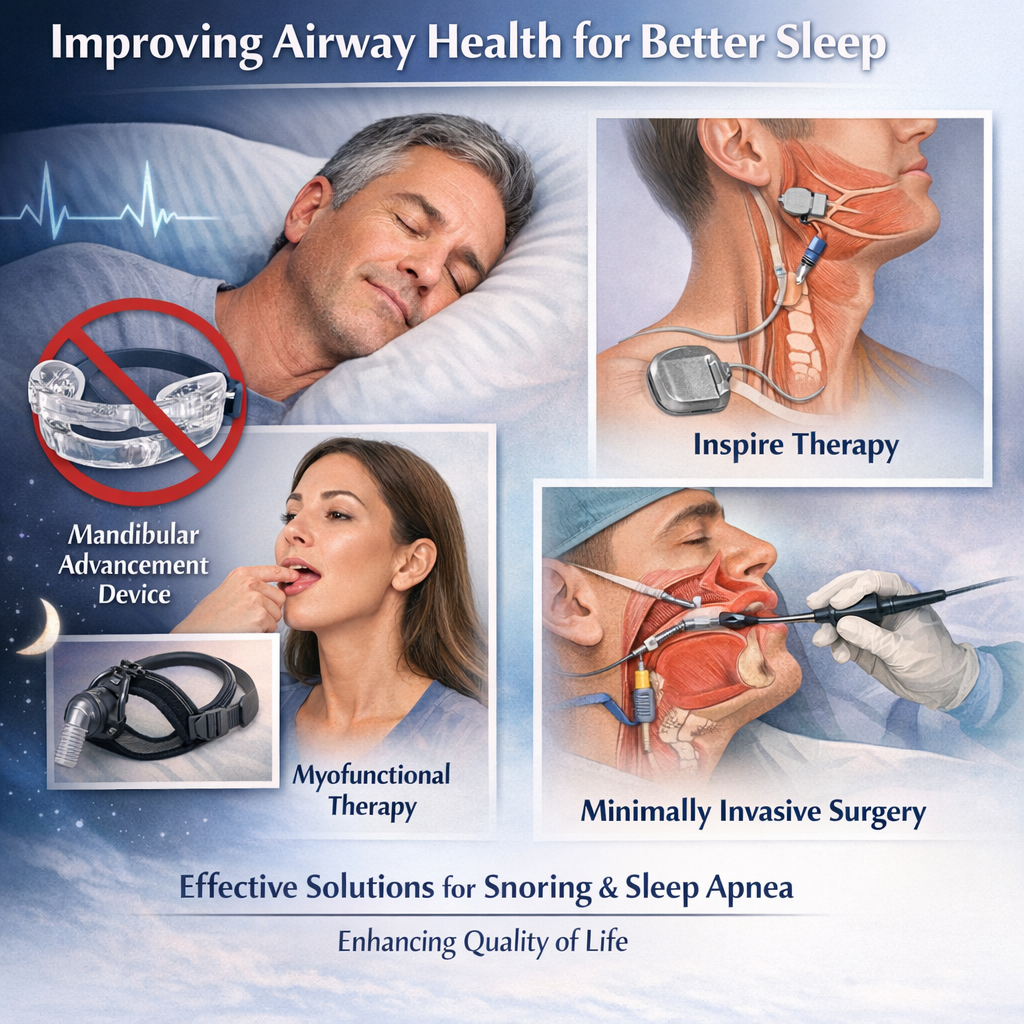
Addressing airway health has traditionally involved medical interventions like **CPAP (Continuous Positive Airway Pressure)** machines. While effective, they are often seen as cumbersome and inconvenient. Recent advancements, however, have paved the way for alternative approaches that are less invasive and more user-friendly. These include advancements in **dental appliances**, minimally invasive surgical procedures, innovative therapies like **myofunctional therapy**, and lifestyle modifications aimed at reducing risk factors like **obesity** and **smoking**.
For instance, **myofunctional therapy** focuses on strengthening the muscles around the airway, thereby reducing the likelihood of collapse during sleep. This therapy includes exercises that train the tongue, soft palate, and facial muscles to function optimally, promoting better airway stability and improved breathing. Similarly, **dental appliances** designed to reposition the jaw can help maintain an open airway, reducing the frequency and severity of sleep apnea episodes. These revolutionary approaches offer hope to those who struggle with traditional methods, providing them with more comfortable and sustainable solutions to their sleep-related problems.
Features: Professional and Medical Studies on Airway Health and Sleep Disorders
Significant **research** has been conducted to explore the link between airway health and sleep disorders, alongside the development of novel treatments. A study published in the [*American Journal of Respiratory and Critical Care Medicine*](https://www.atsjournals.org/doi/full/10.1164/rccm.201101-0059OC) highlighted the effectiveness of myofunctional therapy for patients with **obstructive sleep apnea**. The research demonstrated that patients who engaged in specific exercises experienced a notable reduction in apnea episodes, improvements in sleep quality, and decreased daytime sleepiness. This study underscores the potential of non-invasive, muscle-targeted therapy as a transformative approach for managing sleep apnea.
Moreover, a study published in the [*Journal of Clinical Sleep Medicine*](https://jcsm.aasm.org/doi/10.5664/jcsm.2360) examined the efficacy of **mandibular advancement devices (MADs)** for treating OSA. These dental appliances work by adjusting the position of the lower jaw, thus enlarging the airway and preventing obstructions during sleep. The study concluded that MADs were effective in reducing **apnea-hypopnea index (AHI)** scores and improving sleep efficiency, particularly in patients with mild to moderate OSA. As a less intrusive alternative to CPAP, MADs show promise in enhancing patient compliance and satisfaction.
Recent developments in minimally invasive surgical procedures also hold promise. Techniques like **radiofrequency ablation** and **Inspire therapy** (a surgically implanted device) have shown effectiveness in improving airway patency. Radiofrequency ablation involves using energy to shrink and stiffen the tissue in the throat, reducing airway collapse. Meanwhile, Inspire therapy, approved by the FDA in 2014, uses a gentle pulse to stimulate the hypoglossal nerve, helping maintain airway openness during sleep without interfering with natural breathing. **Research** on Inspire therapy published in the [*New England Journal of Medicine*](https://www.nejm.org/doi/full/10.1056/NEJMoa1314364) reports significant improvements in AHI scores and overall quality of life in patients who underwent this treatment.
These studies and innovations underscore the importance of airway health in sleep medicine, paving the way for a paradigm shift in treatment approaches. By focusing on personalized strategies that address the root causes of sleep disorders, healthcare professionals can offer more patient-friendly options that improve long-term outcomes and life quality.
Conclusion
Unlocking the secrets of airway health has the potential to revolutionize the treatment of sleep disorders. As we continue to uncover the complex relationship between airway anatomy and sleep, new approaches are emerging that promise to enhance life quality in ways we hadn’t envisaged previously. By incorporating non-invasive therapies, innovative technologies, and lifestyle adjustments, patients can experience significant improvements in their sleep and overall wellness. The encouraging results from various studies echo this optimism, highlighting the importance of personalized, patient-centered care in sleep medicine. These insights should empower both patients and healthcare professionals to embrace new, effective methods for managing sleep disorders, ultimately leading to healthier, more restful lives.
Concise Summary
**Airway health** plays a crucial, yet often overlooked, role in the management of **sleep disorders** like **obstructive sleep apnea** and snoring. Recent advances in treatment approaches such as **myofunctional therapy**, **mandibular advancement devices**, and minimally invasive surgeries show promise in improving sleep quality. These alternatives to conventional therapies like CPAP machines offer more patient-friendly solutions by emphasizing non-invasive, personalized strategies. Groundbreaking studies reinforce the effectiveness of these approaches, highlighting improved sleep efficiency and quality of life. Embracing these innovative options signifies a paradigm shift in sleep medicine, ultimately promoting better health and restful lives.

Dominic E. is a passionate filmmaker navigating the exciting intersection of art and science. By day, he delves into the complexities of the human body as a full-time medical writer, meticulously translating intricate medical concepts into accessible and engaging narratives. By night, he explores the boundless realm of cinematic storytelling, crafting narratives that evoke emotion and challenge perspectives.
Film Student and Full-time Medical Writer for ContentVendor.com