Why Snoring Should Be the Next Big Data Revolution in Predictive Health Analytics
**Introduction**
In recent years, **data-driven technology** has transformed various sectors, placing **health analytics** at the forefront of this revolution. As technology advances, it invites opportunities to tap into seemingly mundane aspects of daily life, yielding surprisingly rich data. One such aspect is **snoring**—a phenomenon experienced by an estimated **45% of adults**, according to the **American Sleep Apnea Association**. Despite its commonality, snoring is often viewed as a mere **nighttime nuisance**. However, what if this nightly orchestra were a goldmine of health data, waiting to be deciphered to predict a host of potential health issues?
Snoring is the audible manifestation of **turbulent airflow** during breathing in sleep. It is often seen as benign, albeit disruptive. However, recent studies propose that the nuances of these nightly sounds could possess significant correlations with health conditions, both diagnosed and undiagnosed. Conditions such as **obstructive sleep apnea (OSA)**, **cardiovascular diseases**, and even mental health issues like **depression** have found correlations with snoring severity and frequency.
The potential of snoring as a **predictive analytics** tool lies in the insight it offers into our nocturnal health—a realm often underexplored in traditional health assessments. Unlike standard biometric data, snoring provides real-time insights into respiratory patterns while asleep, a time when the body’s baseline health operates free of daytime influences. The continuous monitoring facilitated by modern technology, such as smart devices, offers an unprecedented avenue for gathering comprehensive sleep data that extends beyond isolated medical assessments.
By leveraging advanced **machine learning algorithms** and **AI frameworks**, health professionals can transform snoring data into actionable intelligence. These technologies enable the extraction of complex patterns from the rhythmic oscillations of snores, correlating them with broader health indicators. Furthermore, the implications for personal healthcare are transformative; predictive analytics from snoring data could herald crucial early warnings to individuals, encouraging timely medical investigation and the introduction of preventive lifestyle changes.
Features
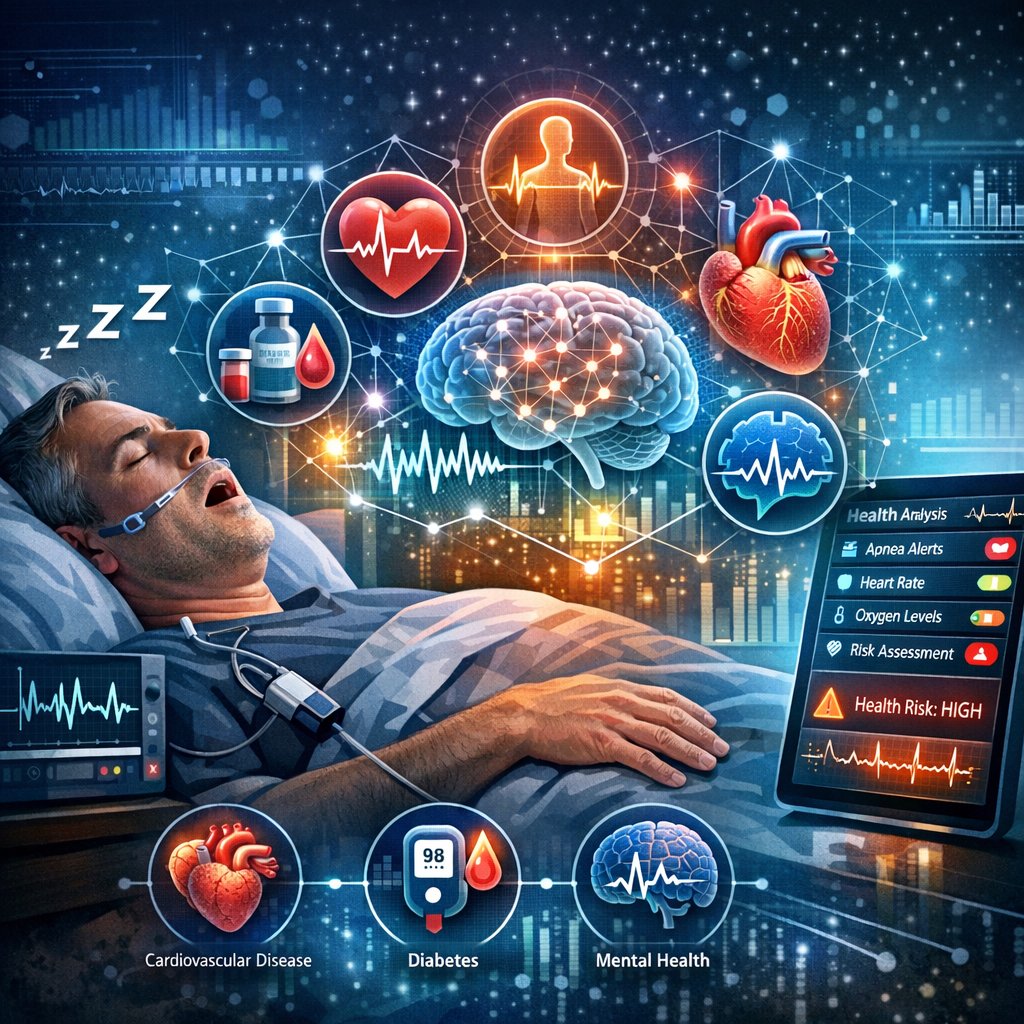
A pivotal study published in the journal [*Chest*](https://journal.chestnet.org/article/S0012-3692(20)30041-4/fulltext) explored the intricate relationship between **snoring** and **cardiovascular risk factors**. The research demonstrated that frequent **snoring**, particularly when categorized alongside symptoms of **sleep apnea**, doubles the risk of **hypertension**, **heart attack**, and **stroke**. Conducted over five years and involving thousands of participants, this study emphasized the critical role snoring patterns play in cardiovascular health monitoring. By integrating predictive analytics with these findings, healthcare providers could personalize patient treatment plans with better accuracy, potentially improving outcomes significantly.
Another noteworthy study from the [*American Journal of Respiratory and Critical Care Medicine*](https://www.atsjournals.org/doi/full/10.1164/rccm.202001-0123LE) examined the connection between **snoring intensity** and **glucose metabolism**, suggesting a potential link between snoring and the development of **type 2 diabetes**. The research exposed that high-decibel snorers displayed impaired **glucose tolerance**, indicating that snoring could be an early indicator of **metabolic syndrome**. Thus, capturing and analyzing snoring data could revolutionize how medical practitioners screen for diabetes, moving towards preemptive management rather than reactive treatment.
Moreover, the role of snoring data in assessing **mental health** is gaining traction, with a study in [*Sleep Medicine Reviews*](https://www.sciencedirect.com/science/article/pii/S1087079219310203) exploring the association between poor sleep, as characterized by snoring, and increased incidence of **depression** and **anxiety**. Disrupted sleep caused by snoring may alter the balance of **neurotransmitters** in the brain, leading to mood disorders. With the ability to track and analyze these disruptions over extended periods, predictive health analytics could offer early intervention possibilities before clinical symptoms manifest.
Collectively, these studies exemplify the vast potential of snoring data in **predictive health analytics**. By turning our attention to the subtleties of sleep-induced sounds, we stand on the precipice of a healthcare revolution that could shift the paradigm from passive diagnosis to proactive prevention.
Conclusion
In conclusion, the transformative potential of **snoring data** extends beyond the boundaries of traditional health monitoring, offering a new dimension of personalized healthcare. This overlooked aspect of sleep holds the key to unlocking **predictive models** that foresee a range of health issues—from **cardiovascular** and **metabolic disorders** to mental well-being. As our understanding deepens and technology advances, the value of integrating snoring analytics into routine health assessments becomes increasingly undeniable. Embracing this innovative approach paves the way for a proactive healthcare system that prioritizes preemptive action over reactive measures, ensuring enhanced health outcomes and improving quality of life. Our snores, once seen merely as a nocturnal inconvenience, are poised to become a cornerstone of future health predictions, driving the next big data revolution in healthcare.
**References**
1. **American Sleep Apnea Association**. [Snoring](https://www.sleepapnea.org/learn/sleep-apnea/what-is-sleep-apnea/snoring/).
2. Excerpt from “Habitual Snoring, Obstructive Sleep Apnea Syndrome and Cardiovascular Disease” published in *Chest*. [Study on Cardiovascular Risks](https://journal.chestnet.org/article/S0012-3692(20)30041-4/fulltext).
3. **American Journal of Respiratory and Critical Care Medicine**. [Study on Snoring and Metabolic Syndrome](https://www.atsjournals.org/doi/full/10.1164/rccm.202001-0123LE).
4. **Doi T., et al.** “Snoring, Sleep, and Mood Disorders.” *Sleep Medicine Reviews*. [Link to study](https://www.sciencedirect.com/science/article/pii/S1087079219310203).
**Concise Summary**
Snoring, often seen as a mere nighttime disturbance, is emerging as a rich source of health data with the potential to predict various health issues such as **obstructive sleep apnea**, **cardiovascular diseases**, **type 2 diabetes**, and even **mental health conditions** like **depression** and **anxiety**. Advances in **technology**, including **machine learning** and **AI**, can convert snoring data into actionable insights, offering predictive analytics for early intervention and personalized healthcare. This innovative approach could significantly transform healthcare from reactive to proactive, elevating health outcomes and enhancing quality of life.

Dominic E. is a passionate filmmaker navigating the exciting intersection of art and science. By day, he delves into the complexities of the human body as a full-time medical writer, meticulously translating intricate medical concepts into accessible and engaging narratives. By night, he explores the boundless realm of cinematic storytelling, crafting narratives that evoke emotion and challenge perspectives.
Film Student and Full-time Medical Writer for ContentVendor.com