Can AI Models Predict Heart Attack Risk from Sleep Data? Exploring the Future of Sleep Diagnostics
Introduction
The relationship between **sleep** and **heart health** has been a subject of extensive research for many years. Today, we are on the verge of a groundbreaking shift in how we understand and assess the risks associated with heart health, thanks to advancements in **artificial intelligence (AI)** technology. The idea that AI models could predict **heart attack** risks based on sleep data is not merely science fiction but a rapidly approaching reality.
**Sleep**, often underrated, plays a critical role in overall health and well-being. It is during sleep that the body undergoes significant **restorative processes**, including tissue growth, muscle repair, and protein synthesis. However, disturbances in sleep patterns are directly linked to various health issues, particularly **cardiovascular diseases**. Sleep disorders such as **obstructive sleep apnea (OSA)**, **insomnia**, and **restless legs syndrome** are known to increase the risk of heart attacks and other cardiovascular events.
**AI technology** has opened new frontiers in health diagnostics by leveraging vast amounts of data to uncover patterns and predictions that were previously unreachable with traditional methods. **Machine learning algorithms**, a subset of AI, can process complex datasets, such as those collected from sleep studies, to identify subtle correlations between sleep patterns and cardiovascular health risks. This process involves analyzing variables like sleep duration, sleep quality, breathing irregularities, and heart rate variability.
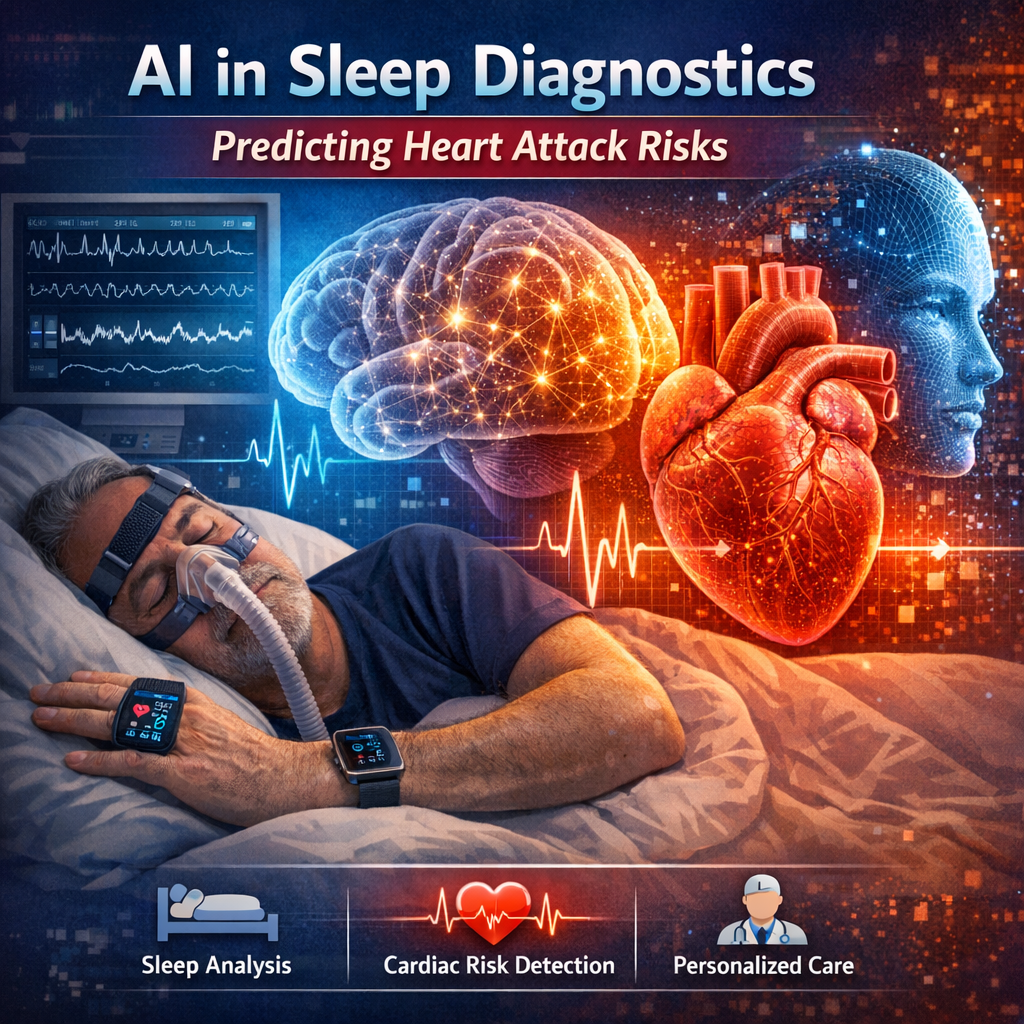
Recent advances in **wearable technology** and home monitoring devices have made it easier for individuals to track their sleep patterns and collect a wealth of data. This vast pool of **sleep data**, when analyzed with sophisticated AI models, may offer unprecedented insights into predicting heart health risks. The integration of AI in sleep diagnostics is not only promising for early detection but potentially life-saving, as timely intervention can significantly alter the course of heart disease.
Understanding how **AI-driven sleep diagnostics** can contribute to the prediction of heart attack risks requires a closer look at the ongoing research and studies being conducted in this field. As we delve deeper into the features section, we’ll explore some of the prominent studies and their findings that highlight the potential of AI in revolutionizing sleep diagnostics and heart health.
Features
In recent years, numerous studies have explored the intersection of AI technology with sleep data to predict cardiovascular health outcomes. One pioneering study conducted by researchers at the [**Massachusetts Institute of Technology (MIT)**](https://news.mit.edu/2020/ai-sleep-diagnostics-0921) used machine learning algorithms to analyze sleep data and successfully identified patterns indicative of high blood pressure and other cardiovascular conditions. The study utilized **polysomnography data**, which includes comprehensive measurements of brain waves, oxygen levels, heart rate, and breathing, to train AI models in recognizing complex data patterns associated with heart health risks.
Another notable study published in the [“Journal of Clinical Sleep Medicine”](https://jcsm.aasm.org/doi/full/10.5664/jcsm.8120) focused on using AI to detect **obstructive sleep apnea (OSA)** and its related cardiovascular risks. By analyzing the nocturnal oxygen saturation levels and corresponding heart rates, AI models were able to predict not only the presence of OSA but also the increased likelihood of cardiovascular events in affected individuals. This study highlighted the potential of integrating AI with home-based sleep monitoring systems for early and accurate detection of sleep-related cardiovascular risks.
In a research project led by the **University of California, San Diego**, [AI algorithms](https://ucsdnews.ucsd.edu/pressrelease/ai-sleep-heart-attack-risk) were employed to process data from wearable sleep trackers. This innovative approach allowed researchers to assess the relationship between micro-level sleep disturbances and the risk of acute myocardial infarction. **Machine learning** models effectively identified subtle sleep pattern variations, such as frequent awakenings and irregular breathing, which were indicative of increased heart attack risks.
The potential benefits of AI-driven sleep diagnostics extend beyond individual patient care. Large-scale epidemiological studies can use AI models to sift through massive datasets, providing insights into population-level trends in sleep health and heart disease. This capability enhances public health strategies by identifying **at-risk populations** and advising targeted interventions.
While the promise of AI in predicting heart attack risks from sleep data is immense, it’s crucial to acknowledge the challenges that accompany these advancements. Ethical considerations, data privacy, and the need for standardized methodologies in sleep data collection and analysis are some of the hurdles that researchers and practitioners must address to fully realize the potential of AI in this domain.
Conclusion
As AI technology continues to evolve, its integration into sleep diagnostics holds enormous promise for transforming cardiovascular health outcomes. By harnessing the power of AI to analyze intricate patterns in **sleep data**, we can achieve a more predictive and preventative healthcare model. This proactive approach could lead to earlier diagnosis, personalized treatment plans, and ultimately, reduced incidence of heart attacks and related complications.
The implications of AI-driven sleep diagnostics are far-reaching, from reducing healthcare costs to improving quality of life for individuals with sleep disorders. However, collaboration between technology developers, healthcare professionals, and policymakers is essential to ensure that these innovations are implemented ethically and effectively.
With continued research and advancements in **AI modeling**, the dream of predicting heart health risks from sleep data is within our grasp. The future of sleep diagnostics is poised to be a game-changer in the fight against cardiovascular disease, offering hope to millions around the world who are at risk of heart attacks and related conditions.
**Concise Summary**
Advancements in **AI technology** are transforming the prediction of heart attack risks through the analysis of sleep data. Researchers demonstrate AI’s potential by identifying heart health risks linked to sleep disorders like **obstructive sleep apnea**. With the integration of **wearable tech** and AI in diagnostics, early detection and intervention for cardiovascular issues seem promising. However, addressing ethical and privacy concerns is critical to fully harness AI’s benefits in sleep diagnostics, aiming for personalized healthcare and improved population health outcomes.
**References**
1. [MIT News: AI in Sleep Diagnostics](https://news.mit.edu/2020/ai-sleep-diagnostics-0921)
2. [Journal of Clinical Sleep Medicine: AI and Sleep Apnea](https://jcsm.aasm.org/doi/full/10.5664/jcsm.8120)
3. [University of California, San Diego Research on AI and Sleep](https://ucsdnews.ucsd.edu/pressrelease/ai-sleep-heart-attack-risk)

Dominic E. is a passionate filmmaker navigating the exciting intersection of art and science. By day, he delves into the complexities of the human body as a full-time medical writer, meticulously translating intricate medical concepts into accessible and engaging narratives. By night, he explores the boundless realm of cinematic storytelling, crafting narratives that evoke emotion and challenge perspectives.
Film Student and Full-time Medical Writer for ContentVendor.com