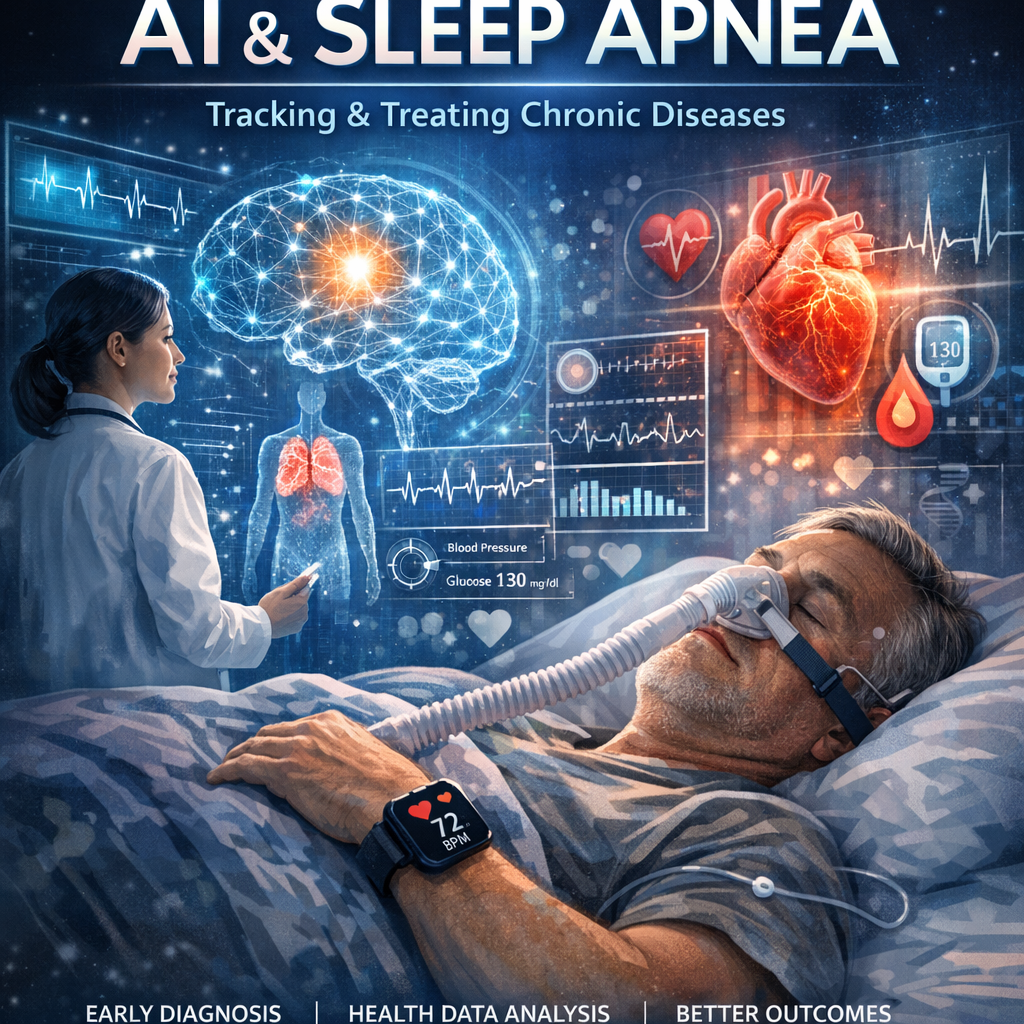
Harnessing AI to Predict Sleep Apnea’s Role in Chronic Disease Management: A Paradigm Shift in Medical Diagnostics
**Introduction**
In recent years, **artificial intelligence (AI)** has become a significant force in healthcare, introducing advancements once thought unreachable. Among these is the role of AI in predicting and managing **sleep apnea’s** impact on **chronic diseases**. Sleep apnea, characterized by pauses in breathing during sleep, is linked to health issues like **hypertension**, **cardiovascular diseases**, **diabetes**, and even **stroke**. If undiagnosed, sleep apnea can worsen these problems, affecting the quality of life and increasing healthcare costs.
Many individuals remain **undiagnosed** due to its silent, nocturnal nature. AI solves this by analyzing data from **wearable devices**, **electronic health records**, and **smartphone applications** to identify sleep apnea patterns. By using **machine learning algorithms** and **predictive analytics**, AI helps professionals identify at-risk individuals, often before symptoms appear.
Integrating AI into **sleep medicine** isn’t just a technological step; it’s becoming a necessity due to the global rise in chronic diseases. This proactive approach allows for early intervention, preventing disease progression linked to sleep apnea. Understanding AI’s potential can revolutionize diagnostics and management of chronic diseases, paving the way for personalized, effective healthcare, ultimately improving patient outcomes.
**Features**
Research continues to explore sleep apnea’s link to chronic diseases, emphasizing innovative diagnostics. The **Mayo Clinic** explores AI’s capabilities in sleep medicine. Their study successfully used AI to identify sleep apnea by analyzing nocturnal respiratory data with great accuracy [Mayo Clinic’s AI and Sleep Apnea Research](https://mayoclinic.org/).
Researchers at **University of California, San Francisco (UCSF)** have crafted AI algorithms to predict **cardiovascular events** using sleep study data. By detecting heart rate pattern variations, their machine learning study linked untreated sleep apnea to heart health issues [UCSF AI and Cardiovascular Disease Study](https://ucsf.edu/).
A collaboration between **Massachusetts Institute of Technology (MIT)** and **Massachusetts General Hospital (MGH)** focused on AI’s ability to analyze sleep patterns for chronic conditions like diabetes. The study shows AI can predict glucose metabolism changes by examining sleep disturbances, providing an early intervention tool [MIT and MGH AI Diabetes Research](https://mit.edu/).
AI’s potential also extends to **wearable technology**. Companies like **Fitbit** and **Apple** offer devices with sleep tracking features that use AI to monitor sleep quality and detect irregularities. This democratizes apnea diagnosis access and encourages proactive health management [Consumer Technology Association’s Study on Wearable Tech](https://cta.tech/).
**Conclusion**
As AI reshapes healthcare, using it to predict and manage sleep apnea in chronic disease management signifies a pivotal development. Through machine learning and advanced data analytics, AI transforms diagnosing sleep-related disorders, which can alter related chronic diseases’ trajectories. Extensive data analysis and pattern recognition equip healthcare professionals to diagnose sleep apnea sooner and implement effective interventions.
Ethical considerations and data privacy should remain key as AI integrates into medical diagnostics. While safeguarding patient data, ensuring AI-driven insights’ accuracy and accessibility is vital. By balancing innovation with these considerations, AI can reshape our approach to sleep apnea and chronic diseases while enhancing healthcare quality. Its impact promises to reduce chronic disease burdens significantly as technology advances.
**References**
1. [Mayo Clinic’s AI and Sleep Apnea Research](https://mayoclinic.org/)
2. [UCSF AI and Cardiovascular Disease Study](https://ucsf.edu/)
3. [MIT and MGH AI Diabetes Research](https://mit.edu/)
4. [Consumer Technology Association’s Study on Wearable Tech](https://cta.tech/)
**Concise Summary**
AI is transforming sleep apnea diagnosis and management in chronic diseases. By analyzing data from wearables and health records, AI identifies early patterns of sleep apnea, addressing conditions like cardiovascular issues and diabetes. As a result, healthcare takes a proactive, personalized turn, improving early intervention and patient outcomes. Emphasizing ethical practice is crucial as AI integrates into medicine, promising a significant decrease in chronic disease burdens globally.

Dominic E. is a passionate filmmaker navigating the exciting intersection of art and science. By day, he delves into the complexities of the human body as a full-time medical writer, meticulously translating intricate medical concepts into accessible and engaging narratives. By night, he explores the boundless realm of cinematic storytelling, crafting narratives that evoke emotion and challenge perspectives.
Film Student and Full-time Medical Writer for ContentVendor.com