Is AI the Game-Changer in Diagnosing Sleep Apnea? A Deep Dive into Modern Tech’s Role in Sleep Medicine
Introduction
**Sleep apnea**, a condition characterized by pauses in breathing during sleep, impacts millions worldwide. This condition can escalate into severe health issues such as **cardiovascular disease**, **cognitive impairment**, and an overall diminished quality of life. Traditional diagnosis methods, like **polysomnography**, involve overnight sleep studies at specialized clinics. Though comprehensive, these studies are often costly and inconvenient. The emergence of **artificial intelligence (AI)** is poised to revolutionize the diagnosis and possibly even the prediction of sleep apnea.
**AI** consists of computer systems designed to emulate human intelligence processes, including learning and problem-solving. Its role in the medical field is increasingly significant, offering new methods to improve accuracy, efficiency, and accessibility in diagnostics. By leveraging vast datasets, AI algorithms can detect patterns and associations that might be invisible to the human eye, thus serving as a powerful tool for healthcare professionals.
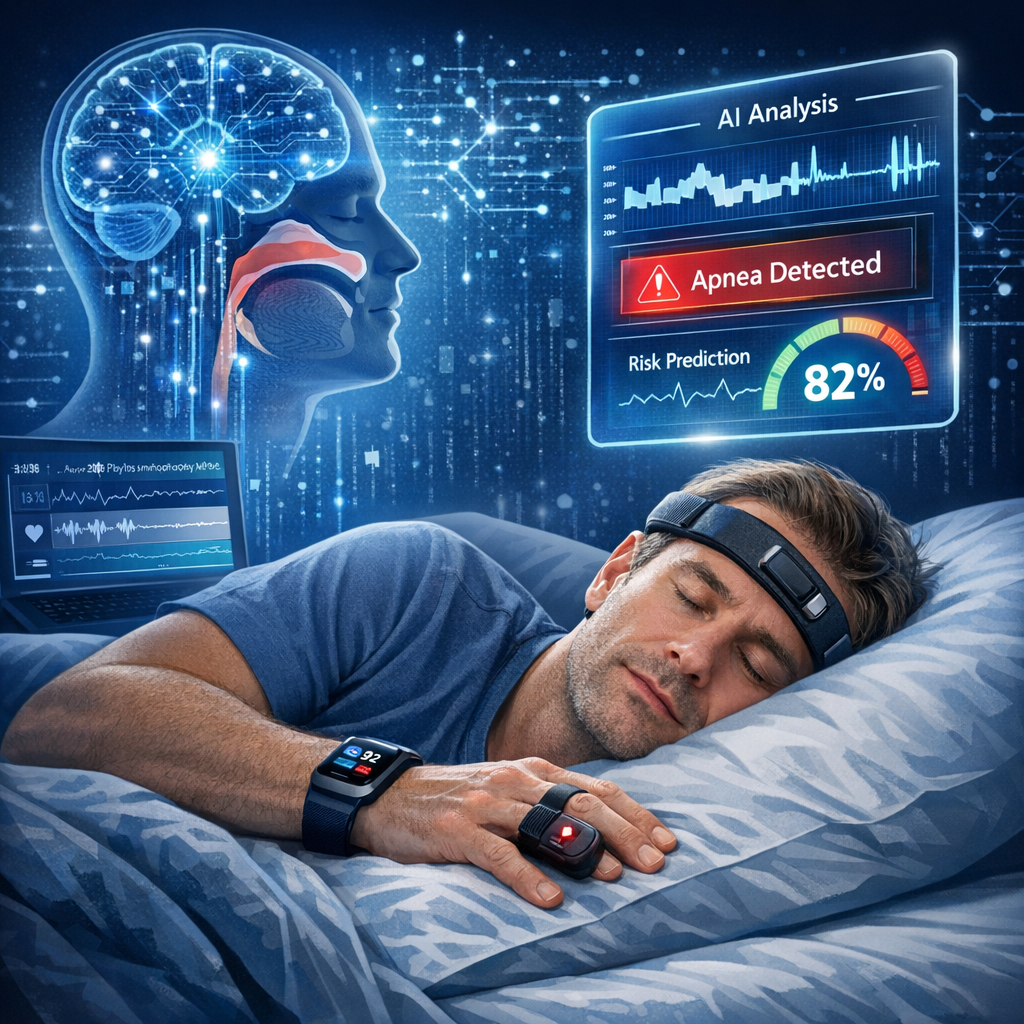
In **sleep apnea diagnosis**, AI simplifies the diagnostic process. AI-driven technology can rapidly analyze sleep data far quicker than manual interpretation, offering timely diagnosis without sacrificing precision. This is particularly advantageous for individuals at risk who cannot or are unwilling to participate in traditional sleep studies. **Wearable technology** and home-based sleep monitoring devices integrated with AI provide a more accessible and comfortable diagnostic option.
Moreover, continued research into AI’s potential to predict sleep apnea risk before the onset of severe symptoms presents exciting preventive possibilities. This proactive approach could reduce the prevalence of sleep apnea and mitigate associated health risks. Prioritizing the development and integration of AI technologies in **sleep medicine** might usher in a new era where sleep diagnostics become more efficient and universally accessible.
Features
Numerous medical studies illustrate AI’s transformative potential in diagnosing **sleep apnea**. A notable 2020 study published in [*Nature Communications*](https://www.nature.com/articles/s41467-020-14724-9) showcased AI algorithms identifying sleep apnea from raw physiological data with high accuracy. Utilizing a large dataset from wearable monitors, researchers found that AI could replicate and even exceed the diagnostic precision of traditional **polysomnography**, significantly enhancing data processing speed.
Another pivotal study by the University of California, San Diego, published in the [*Journal of Clinical Sleep Medicine*](https://jcsm.aasm.org/doi/full/10.5664/jcsm.8508), explored deep learning’s use in automating sleep study analysis. The study showed that AI reduced analysis time by more than half, freeing vital resources and shortening patient wait times. Such advancements are crucial, especially in regions with limited access to sleep medicine specialists.
AI-powered **sleep monitoring devices** like smartphones and smartwatches further demonstrate AI’s diagnostic potential. A 2021 study in [*Sleep Medicine Reviews*](https://www.sciencedirect.com/science/article/abs/pii/S1389945721003457) confirmed that these devices, when paired with machine learning algorithms, achieved promising results in estimating **sleep apnea severity**. They offer the added advantage of long-term monitoring, providing a comprehensive sleep health overview over time.
Looking beyond current diagnostics, researchers assess AI’s predictive abilities in identifying high-risk individuals for sleep apnea. A study in [*The Lancet Digital Health*](https://www.thelancet.com/journals/landig/article/PIIS2589-7500(22)00012-3/fulltext) demonstrated AI’s capacity to analyze electronic health records to forecast **sleep apnea likelihood**, enabling early interventions.
Conclusion
**AI** indeed appears to be a game-changer in diagnosing **sleep apnea**, offering faster, more accurate, and accessible diagnostic means. Integrating AI with current medical practices paves the way for improved patient outcomes and personalized sleep health. Though challenges like **data privacy** concerns and regulatory guidelines are present, the benefits are significant.
Embracing AI in **sleep medicine** represents a viable path forward, promising considerable advances in diagnosing and managing sleep disorders such as sleep apnea. As research continues and technology embeds deeper into healthcare systems, we may soon experience a healthcare landscape where sleep disorders are seamlessly identified, addressed, and managed, ensuring better sleep health worldwide.
Concise Summary
Artificial intelligence (AI) is transforming sleep apnea diagnosis by offering fast, accurate, and accessible alternatives to traditional methods like polysomnography. AI-driven algorithms can analyze vast datasets, improving diagnostic precision and speed. Studies demonstrate AI’s potential to replicate or exceed traditional diagnostic accuracy, significantly shortening analysis times and facilitating early detection, even through wearable devices. Though challenges like data privacy and regulation persist, integrating AI in sleep medicine can enhance patient outcomes, promising a future of efficient sleep disorder management and improved sleep health globally.

Dominic E. is a passionate filmmaker navigating the exciting intersection of art and science. By day, he delves into the complexities of the human body as a full-time medical writer, meticulously translating intricate medical concepts into accessible and engaging narratives. By night, he explores the boundless realm of cinematic storytelling, crafting narratives that evoke emotion and challenge perspectives.
Film Student and Full-time Medical Writer for ContentVendor.com