Pioneering Brainwave Rhythms: How AI is Redefining Insomnia Diagnosis and Treatment in Sleep Medicine
Introduction
In our fast-paced world, **sleep** has become a luxury few can afford, while **insomnia** affects millions globally. As the quest for a better night’s rest continues, cutting-edge technology is increasingly being utilized to decode the mysteries of sleep disorders. At the forefront is **Artificial Intelligence (AI)**, a tool that is dramatically transforming how we diagnose and treat insomnia.
Traditionally, sleep disorders have been evaluated through methods such as **polysomnography**, a comprehensive testing process that measures various physiological functions during sleep. However, these methods are often cumbersome, expensive, and not always accessible to everyone. This has paved the way for AI innovations that incorporate **brainwave data** to enhance our understanding of sleep patterns. AI algorithms can process vast amounts of data rapidly, identifying patterns and anomalies that might go unnoticed by human analysis. By examining brainwave rhythms, AI can provide insights into how different stages of sleep are affected by insomnia, giving medical professionals a nuanced understanding of the disorder.
Moreover, **AI’s ability to adapt and learn** makes it an ideal candidate for improving personalized treatment plans. While traditional treatments for insomnia include cognitive behavioral therapy and medication, AI can create customized intervention plans based on individual brainwave patterns and history. This personalization aspect is particularly promising, as it can potentially mitigate issues such as drug dependence and curb ineffective treatment strategies.
These advancements are not merely theoretical. Several medical studies and ongoing research projects are demonstrating the efficacy of AI in **sleep medicine**. The incorporation of AI in this field not only aims at enhancing diagnostic accuracy but also holds the promise of developing effective interventions that could revolutionize the way we manage and treat insomnia.
Features
AI’s role in redefining insomnia diagnosis and treatment has been supported by various studies and ongoing research. A study published in the journal [**Nature and Science of Sleep**](https://www.dovepress.com/artificial-intelligence-in-sleep-studies-improving-accuracy-and-access-peer-reviewed-fulltext-article-NSS) utilized AI to analyze polysomnography data from individuals suffering from insomnia. The research showed that AI models could identify sleep patterns with 90% accuracy, surpassing traditional manual scoring’s efficiency.
Moreover, another study by the [**American Academy of Sleep Medicine (AASM)**](https://www.aasm.org/) explored AI’s potential in predicting insomnia-related health outcomes. Here, AI analyzed longitudinal data and identified patterns linking certain brainwave activities to specific insomnia symptoms, thus predicting potential health risks like **anxiety** and **depression** with high precision. This ability to predict comorbid conditions could play a pivotal role in proactive treatment strategies.
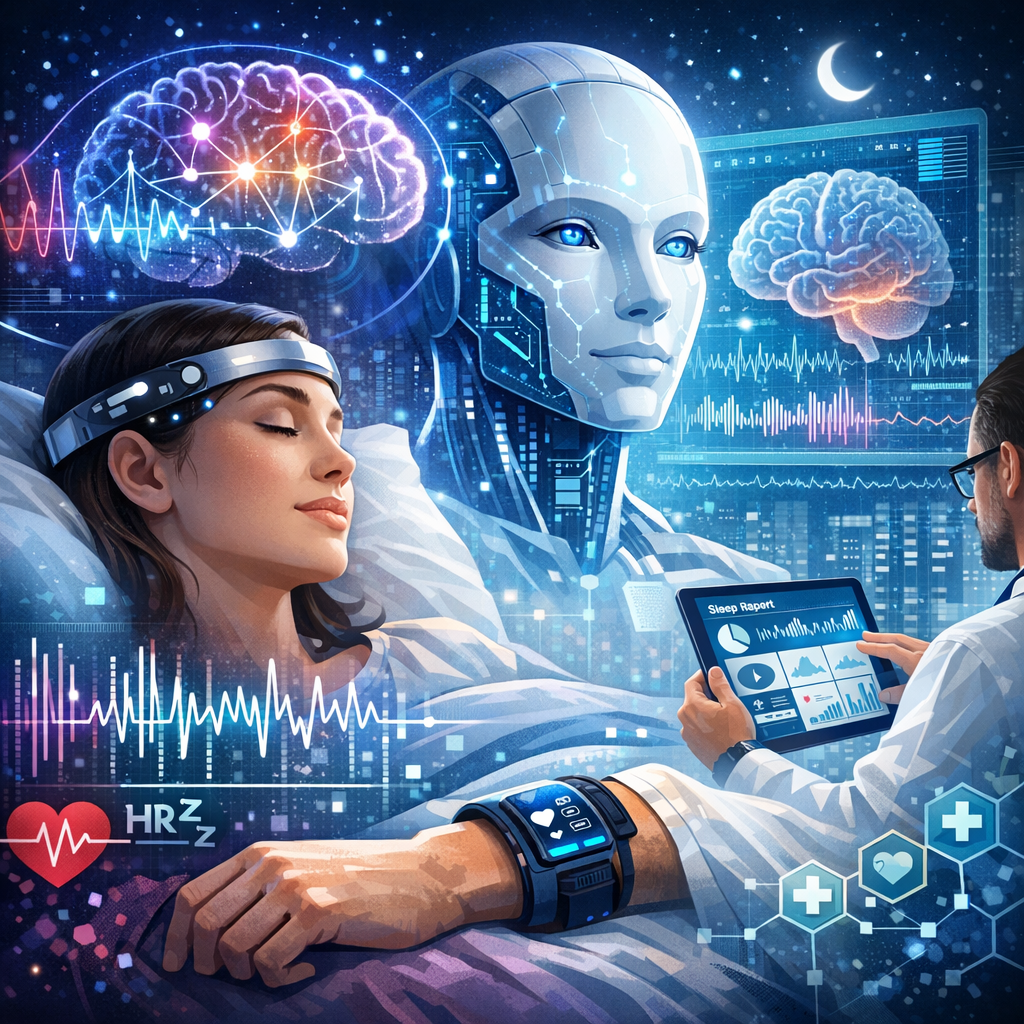
Researchers at [**Stanford University**](https://sleep.stanford.edu/research/) have also been developing AI algorithms that focus on **EEG (electroencephalogram)** data to examine real-time brainwave changes during sleep. Their findings indicate that AI can synchronize brainwave activities in a way that aids real-time diagnosis and provides feedback to patients through wearable devices. This offers promise not only for improved diagnostic techniques but also for the potential to develop **AI-driven biofeedback therapies** where individuals receive immediate feedback on their sleep quality, allowing real-time intervention.
In addition, AI’s proficiency in managing large datasets enhances researchers’ ability to conduct **meta-analysis studies**. AI can synthesize findings from multiple studies, provide comprehensive insights into effective treatment strategies, and identify potential areas of research that require further exploration. This presents opportunities to refine existing treatment modalities, ultimately leading to more effective ways of managing insomnia.
Conclusion
As AI continues to evolve, its integration into sleep medicine becomes increasingly promising. The potential that AI holds in revolutionizing insomnia diagnosis and treatment is immense, offering more accessible, accurate, and personalized care. The rapid analysis capabilities of AI and its predictive analytics offer newfound hope for those struggling with insomnia, enabling treatment approaches that are both proactive and effective.
AI’s influence in sleep medicine extends beyond immediate clinical applications. It serves as a foundation for future research, inspiring further investigation into sleep disorders. As we stand on the verge of a new era in insomnia treatment, it becomes clear that the incorporation of AI could prove to be a transformative force, not only enhancing our understanding of insomnia but potentially alleviating the burden it places on individuals worldwide. While challenges like **data privacy** and the need for extensive validation remain, the progress made thus far represents a significant leap forward in sleep health, signaling a bright future where better sleep is attainable for all.
Concise Summary
Artificial intelligence is revolutionizing insomnia diagnosis and treatment by analyzing brainwave data to understand sleep patterns. Traditional methods like polysomnography are often inaccessible, while AI offers rapid data processing and personalized treatment plans. Studies show AI’s high accuracy in diagnosing insomnia and its ability to predict related health conditions, enhancing proactive treatment strategies. AI also enables real-time feedback through wearable devices, improving diagnostic techniques and facilitating AI-driven therapies. While challenges like data privacy exist, AI’s potential to transform sleep medicine and provide effective, personalized care is immense, promising a future of better sleep for all.

Dominic E. is a passionate filmmaker navigating the exciting intersection of art and science. By day, he delves into the complexities of the human body as a full-time medical writer, meticulously translating intricate medical concepts into accessible and engaging narratives. By night, he explores the boundless realm of cinematic storytelling, crafting narratives that evoke emotion and challenge perspectives.
Film Student and Full-time Medical Writer for ContentVendor.com