Revolutionizing Sleep Medicine: How AI-Driven Precision Diagnostics Are Preventing Chronic Diseases Before They Start
Introduction
The world of **sleep medicine** is undergoing a transformative shift, driven by the advent of **artificial intelligence (AI)** and its potential to revolutionize **diagnostics** and **treatment paradigms**. **Sleep**, a vital pillar of health, has often been overshadowed by more quantifiable health behaviors such as **diet** and **exercise**. However, chronic sleep disorders are increasingly recognized as silent saboteurs of health, contributing to a plethora of chronic diseases like **cardiovascular disorders, diabetes,** and **depression**.
Traditionally, diagnosing sleep disorders such as **obstructive sleep apnea (OSA)**, **insomnia**, or **restless legs syndrome** relies heavily on subjective assessments and the use of generalized protocols. Despite advances in **polysomnography** and **home sleep tests**, there’s been a gap in personalized diagnostics and treatments that cater to individual variances. Enter **AI-driven precision diagnostics**, which hold the promise of transforming sleep medicine by enabling earlier detection and providing personalized treatment plans.
AI systems analyze vast amounts of data far beyond human capability, uncovering hidden patterns and anomalies that could signal the onset of diseases much earlier than traditional methods. For example, AI can process data from **wearable devices**, **electronic health records**, and even **genetic markers** with remarkable precision, paving the way for highly personalized medicine. Not only can this technology flag potential sleep-related issues early, but it also aids in understanding the complex interactions between sleep and various body systems, offering insights that were previously out of reach.
Moreover, AI-powered tools can provide a continuous learning curve. As more sleep data is collected and fed into the algorithms, the predictions become more accurate. This iterative learning capability also allows for adaptive treatment strategies that evolve with the patient, ensuring interventions remain effective over time. Such advancements could drastically reduce the incidence of chronic diseases linked to poor sleep, revolutionizing preventative healthcare and improving overall public health outcomes.
Features
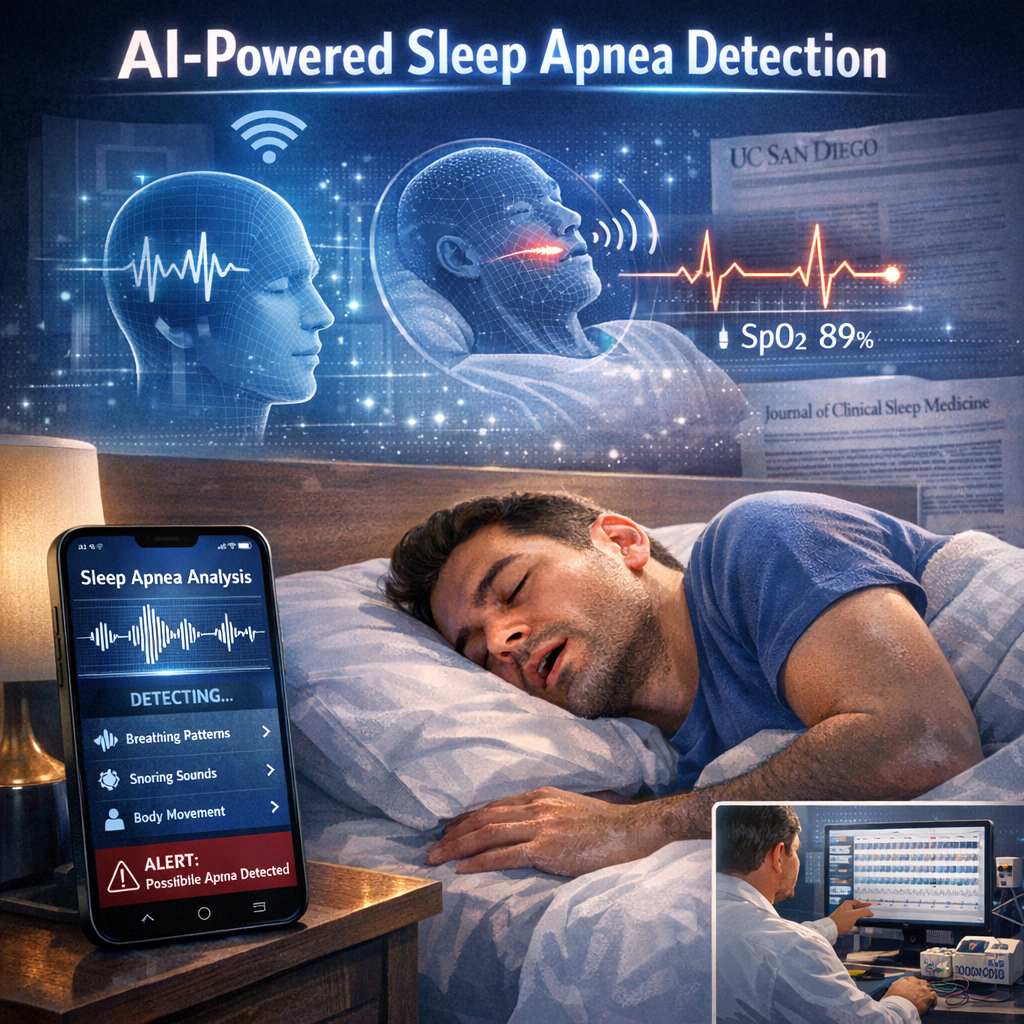
Recent professional and medical studies have underscored the transformative impact of AI in sleep medicine. A study published in *[Nature Science of Sleep](https://www.nature.com)* highlights how AI algorithms, when fed polysomnographic data, can accurately diagnose **sleep apnea** with a precision that rivals traditional laboratory-based assessments. In this study, researchers found that AI’s ability to analyze **respiratory events**, **sleep cycles**, and **oxygen saturation levels** concurrently resulted in more accurate diagnoses and better-tailored treatment plans.
Furthermore, an article in *[Digital Medicine](https://www.nature.com/digmed)* delves into AI’s capacity to predict **chronic diseases** from sleep patterns. The research included longitudinal studies where wearable devices tracked sleep parameters across large populations. Using AI to analyze this data, the study was able to predict the likelihood of developing conditions such as **hypertension** and **type 2 diabetes** with significant accuracy. The researchers concluded that these predictions could lead to proactive interventions, significantly reducing the incidence of these diseases among at-risk populations.
Additionally, AI-driven chatbots are being tested for their ability to assist in **behavioral sleep medicine**. A pilot program documented in *[Sleep Health](https://www.journalsleep.org)* Journal reviewed the efficacy of AI-enhanced **cognitive behavioral therapy for insomnia (CBT-I)**. The program demonstrated that participants receiving AI-augmented CBT-I experienced more rapid and sustained improvements in sleep quality compared to traditional CBT-I groups. This points to AI’s potential to democratize access to effective sleep therapies by overcoming barriers like therapist availability and wait times.
These studies underscore a growing consensus that AI technologies are not only enhancing diagnostic precision but also enabling new preventative healthcare frameworks. As AI algorithms become more sophisticated, their ability to integrate multi-dimensional health data can significantly amplify the effectiveness of sleep medicine, setting a new standard in both individual and public health.
Conclusion
The integration of **AI-driven precision diagnostics** in sleep medicine is more than a technological advancement—it is a paradigm shift that could redefine preventative healthcare. By offering deeper insights into sleep-related health patterns, AI not only enables early detection and personalized treatment but also empowers individuals to take proactive measures in their health journey. This evolution in sleep medicine has the potential to mitigate the risk of chronic diseases, promoting a healthier society where sleep is rightly recognized and leveraged as a cornerstone of health. As we continue to embrace AI’s capabilities, we look forward to a future where the interplay between sleep and chronic disease is comprehensively understood and effectively managed, revolutionizing preventive healthcare for generations to come.
**Concise Summary:** Artificial intelligence is transforming sleep medicine by enhancing diagnostic precision and enabling highly personalized treatment plans. AI’s ability to process vast amounts of data from various sources allows for early detection of sleep disorders and associated health risks. Research has demonstrated AI’s efficacy in diagnosing sleep apnea, predicting chronic diseases like hypertension and diabetes, and augmenting therapies such as cognitive behavioral therapy for insomnia. These advancements promise a new standard in preventive healthcare, emphasizing sleep as a fundamental component of health and potentially reducing the incidence of chronic illnesses.

Dominic E. is a passionate filmmaker navigating the exciting intersection of art and science. By day, he delves into the complexities of the human body as a full-time medical writer, meticulously translating intricate medical concepts into accessible and engaging narratives. By night, he explores the boundless realm of cinematic storytelling, crafting narratives that evoke emotion and challenge perspectives.
Film Student and Full-time Medical Writer for ContentVendor.com