Untangling Airway Chaos: How AI-Powered Diagnostics and Personalized Medicine Reshape Sleep Apnea Treatment
Sleep is a vital component of overall health, yet millions of people worldwide struggle with sleep disorders that impair their quality of life. Among these disorders, **sleep apnea** stands out due to its prevalence and potential to cause serious health issues, including cardiovascular diseases, diabetes, and increased risk of stroke. Traditionally, diagnosing and treating sleep apnea has been a challenging task, relying on labor-intensive **sleep studies** and one-size-fits-all treatment approaches. However, the advent of **artificial intelligence (AI)** and **personalized medicine** is transforming the landscape of sleep apnea treatment, offering hope for more accurate diagnoses and customized treatment plans.
**Sleep Apnea** is a condition characterized by repeated interruptions in breathing during sleep. These interruptions, known as **apneas** or **hypopneas**, can lead to fragmented sleep and decreased oxygen supply to the body, causing daytime sleepiness, difficulty concentrating, and other health issues. The standard diagnostic tool for sleep apnea is the **polysomnography test**, an overnight study conducted in a sleep lab. While effective, polysomnography is resource-intensive and requires specialized personnel and equipment, which can limit accessibility and delays in diagnosis.
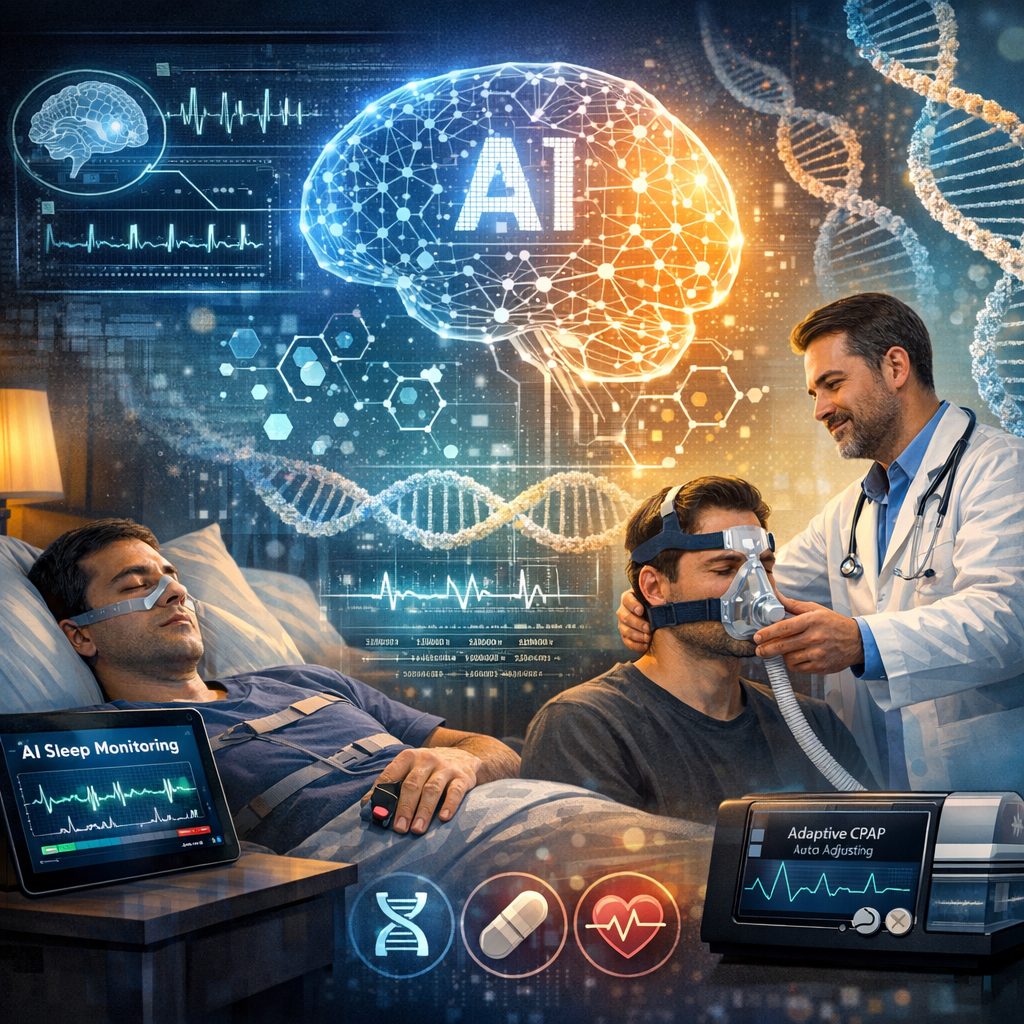
**AI-Powered Diagnostics** are now entering the scene, poised to revolutionize how we detect and understand sleep apnea. These advanced algorithms are trained on vast datasets of sleep patterns and can analyze data from simpler, home-based monitoring devices, offering preliminary detection with a good degree of accuracy. By doing so, AI not only facilitates early diagnosis but also makes sleep study data more accessible to individuals who cannot stay overnight in a sleep lab.
Furthermore, AI can go beyond diagnostics and aid in treatment personalization. Traditional treatment options like **Continuous Positive Airway Pressure (CPAP)** machines, oral appliances, or surgical interventions are often prescribed without considering individual differences in anatomy, lifestyle, and responses to treatment. AI systems, leveraging machine learning models, can predict how patients may respond to different therapies based on their unique profiles, thereby tailoring treatment plans that are more likely to succeed.
Features Section
Significant progress has been achieved in the field of AI applications for sleep apnea through various research studies and medical trials. For instance, a study published in the [Journal of Clinical Sleep Medicine](https://jcsm.aasm.org/doi/10.5664/jcsm.8708) investigated an AI algorithm’s capability to detect sleep apnea using pulse oximetry signal analysis, offering an impressive reliability that nearly matches conventional sleep studies. By adapting such technologies, a larger portion of the population can receive early screening much more conveniently and cost-effectively.
Another compelling study from the [University of California, San Diego](https://pubmed.ncbi.nlm.nih.gov/31412347/) explored the potential of utilizing AI for personalizing **CPAP therapy**. The researchers developed an algorithm capable of analyzing breathing patterns to customize CPAP machine settings, which resulted in improved patient outcomes and compliance.
Moreover, insights from machine learning are being employed to understand the genetic and phenotypic variations contributing to sleep apnea severity. Personalized medicine, in conjunction with AI, allows physicians to factor in genetic profiles while devising treatment strategies, paving the way for pharmacogenomics approaches to manage the condition. A study appearing in [Nature Communications](https://www.nature.com/articles/s41467-019-13828-0) demonstrated how integrating genetic data with machine learning models could accurately predict individuals’ risk levels for sleep apnea.
AI-powered tools are also helping clinicians monitor treatment efficacy and adjust interventions dynamically. For example, mobile health apps integrated with AI can analyze patient data in real-time, providing immediate feedback to both patients and doctors for ongoing treatment adjustments, thus enhancing adherence and efficacy over the long term.
Conclusion
The integration of AI and personalized medicine in sleep apnea management is a promising development that brings precision, accessibility, and efficiency to the forefront of care. AI-driven diagnostics simplify the detection process and enable timely interventions, while personalized treatment plans cater to the unique needs of each patient, significantly improving outcomes. As healthcare providers adopt these innovative tools, the burden of sleep apnea may be significantly reduced, illustrating how technology can be harnessed to solve complex medical challenges. As we continue to advance in this direction, the future of sleep health looks brighter than ever, promising not only better sleep but also a profound improvement in the overall quality of life for countless individuals.
For further reading, consult these resources:
– [Journal of Clinical Sleep Medicine](https://jcsm.aasm.org/doi/10.5664/jcsm.8708)
– [Nature Communications](https://www.nature.com/articles/s41467-019-13828-0)
– [University of California, San Diego study](https://pubmed.ncbi.nlm.nih.gov/31412347/).
**Concise Summary:**
**AI-powered diagnostics** and **personalized medicine** are reshaping **sleep apnea** treatment by enabling more accurate diagnoses and customized treatment plans. AI facilitates early detection with home-based monitoring, while personalized medicine considers genetic and phenotypic differences for tailored interventions. Studies show AI’s effectiveness in diagnostics and improving **CPAP therapy** outcomes. By integrating genetic data, AI predicts sleep apnea severity and personalizes treatment strategies. This advancement makes sleep apnea care more accessible, efficient, and effective, enhancing patient quality of life. Hyperlinked studies underscore AI’s promising role in transforming sleep health management.

Dominic E. is a passionate filmmaker navigating the exciting intersection of art and science. By day, he delves into the complexities of the human body as a full-time medical writer, meticulously translating intricate medical concepts into accessible and engaging narratives. By night, he explores the boundless realm of cinematic storytelling, crafting narratives that evoke emotion and challenge perspectives.
Film Student and Full-time Medical Writer for ContentVendor.com