Beyond CPAP: Exploring the Future of AI-Driven, Personalized Sleep Apnea Treatments
Introduction
**Sleep apnea** is a prevalent disorder characterized by repeated interruptions in breathing during sleep. This condition not only disrupts rest but can lead to significant health issues, including **cardiovascular diseases** and **diabetes**. Traditionally, **Continuous Positive Airway Pressure (CPAP)** therapy has been the cornerstone treatment for **obstructive sleep apnea (OSA)**. Despite its effectiveness, CPAP falls short in terms of comfort and compliance, with many patients struggling to adhere to therapy. In response to these challenges, the medical field is witnessing a technological revolution that promises a brighter future for those affected by sleep apnea. At the forefront of this evolution is **Artificial Intelligence (AI)**, which holds the potential to transform sleep apnea treatment by delivering personalized, data-driven solutions.
AI-driven approaches to sleep apnea stem from the broader concept of **precision medicine**, tailoring healthcare to the individual characteristics of each patient. This calls for a deeper understanding of sleep patterns, anatomical differences, and even genetic predispositions which play crucial roles in OSA. Through **machine learning algorithms** and data analytics, AI can provide insights previously unattainable with traditional methods. This innovation aligns perfectly with an increasingly digital health landscape, where **wearable technologies** and home monitoring devices are becoming ubiquitous. These devices gather vast amounts of data that, when processed with AI, can identify patterns and predict episodes of apnea with remarkable accuracy.
Beyond merely diagnosing sleep apnea, AI will revolutionize treatment by crafting bespoke therapies. It might analyze massive datasets to suggest alternative treatment options, ranging from positional therapy to oral appliances or even recommending lifestyle changes with predictive impact assessments. Moreover, the integration of AI with emerging technologies, such as **robotics** and **3D printing**, shows promise. It’s conceivable that such synergy could lead to the development of tailored CPAP masks or entirely new devices custom-fit to individual physiological needs.
The shift away from generic therapy solutions towards personalized medicine is already gaining traction amongst both researchers and clinicians. Government and private sector funding are pouring into AI-related sleep research, underscoring the importance of finding more effective and patient-friendly solutions. As these technologies mature, they offer not just improved therapeutics but empower patients with actionable insights to manage their conditions proactively. With growing evidence of the dire health risks posed by untreated sleep apnea, the advent of AI-driven solutions offers a lifeline, potentially improving quality of life for millions.
Features
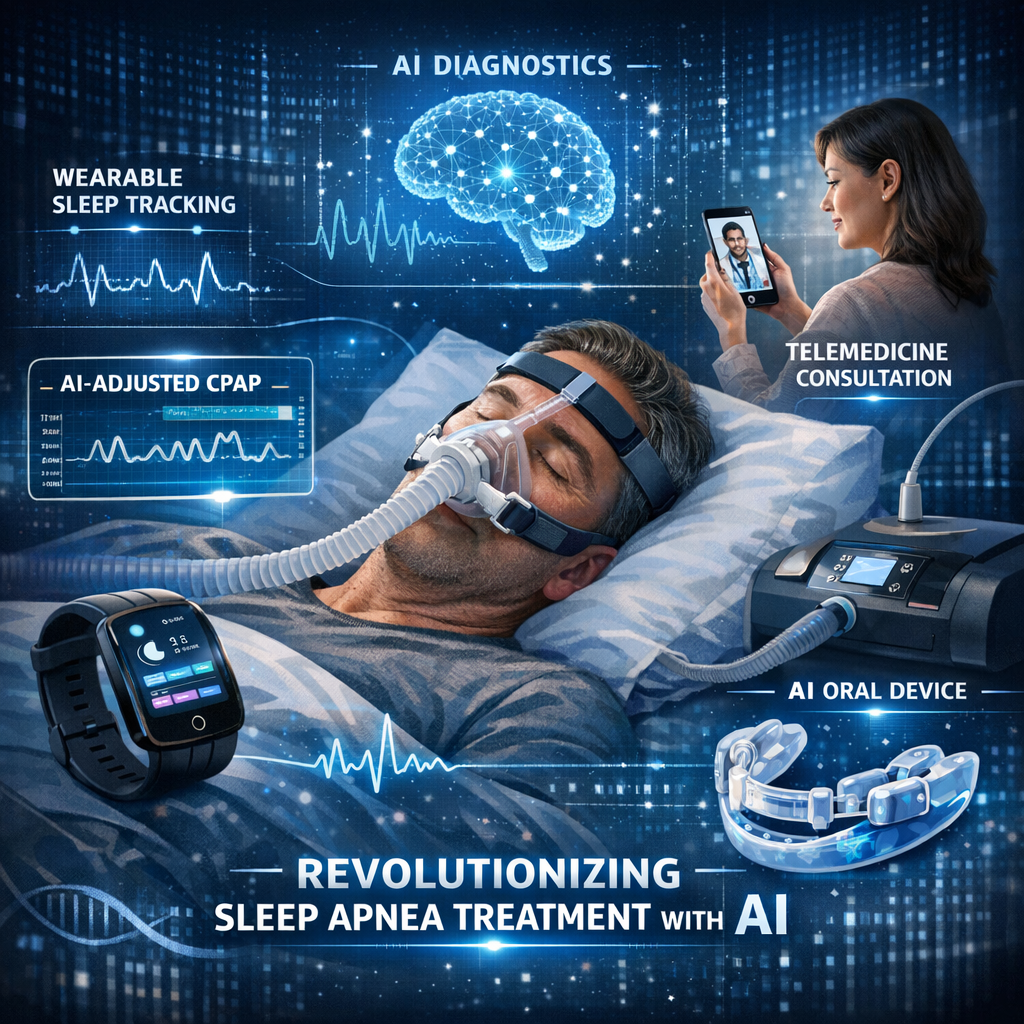
A plethora of recent studies and trials underline the transformative potential of AI in treating sleep apnea. A notable example is a study conducted by researchers at the **University of California, San Francisco**, which explored the efficacy of **machine learning** in predicting apnea events. By employing predictive algorithms on data from wearable sleep monitors, researchers achieved diagnostic accuracy comparable to traditional **polysomnography**, often referred to as the gold standard for sleep diagnosis (Source: [UCSF Study](https://www.ucsf.edu/news)).
In another groundbreaking study published in *The Lancet Digital Health*, scientists examined the effectiveness of AI-driven mechanisms in optimizing CPAP therapy settings. Using **deep learning**, they could regularly adjust device parameters in response to real-time patient data, leading to increased patient compliance and comfort (Source: [The Lancet Digital Health](https://www.thelancet.com/journals/landig/article)). In proof-of-concept trials, these dynamic adjustments reduced the instances of apneic episodes significantly over the traditionally static CPAP settings.
Further exciting developments are emerging from collaborations between tech companies and universities. For instance, a partnership between **Intel** and **Stanford University** is pioneering the use of AI for developing predictive models that not only diagnose sleep apnea but also suggest personalized treatments (Source: [Stanford Medicine](https://med.stanford.edu/news)). These models are expected to advance beyond providing real-time insights into adherence parameters and physiological nuances unique to each patient.
Additionally, AI is driving innovation in non-invasive treatment alternatives. One promising avenue involves AI-enhanced oral devices. Research conducted by the **Harvard School of Dental Medicine** is investigating supports that utilize 3D scans of the patient’s oral cavity and AI algorithms to craft customized mandibular advancement devices, demonstrating significant efficacy in mild to moderate cases of sleep apnea (Source: [Harvard Dental Research](https://hms.harvard.edu/research)). These devices typically offer more comfort than CPAP and show promise in increasing user compliance.
AI’s application in **telemedicine** is also noteworthy; virtual platforms powered by AI can deliver personalized sleep coaching and ongoing monitoring, reducing the dependency on frequent clinic visits. Consequently, this empowers patients with a hands-on approach to tracking and managing their condition, drastically changing the future landscape of sleep healthcare.
Conclusion
The horizon of sleep apnea treatment is indeed broadening beyond the reach of CPAP. **Artificial Intelligence** promises to render personalized, efficient, and patient-centric solutions, thus offering a paradigm shift in sleep medicine. As research and technology continue to evolve, AI-driven personalization heralds an era where therapies are not just about alleviating symptoms but are intricately tailored to the individual. Embracing these advancements may not only improve the therapeutic experience for patients but also address the insidious health consequences tied to untreated sleep apnea. Such technological advancements are critical, given the ubiquity of unmanaged sleep disorders and their cascading effects on global health. As we stand on the cusp of this new era, continued collaboration between technologists, researchers, and clinicians will pave the way for transformative care that ultimately benefits millions worldwide.
Summary
The future of sleep apnea treatment is advancing significantly with the integration of **Artificial Intelligence (AI)**. **AI-driven solutions** aim to overcome the limitations of traditional **CPAP** therapy by providing personalized, data-driven treatments. Using **machine learning algorithms**, wearable technologies, and home monitoring devices, AI can offer insights into sleep patterns, improving diagnostic accuracy and treatment efficiency. Recent studies highlight the potential of AI to enhance CPAP settings and suggest non-invasive alternatives like AI-enhanced oral devices. This personalized approach, supported by ongoing research and technological innovation, offers hope for better patient compliance and improved health outcomes.

Dominic E. is a passionate filmmaker navigating the exciting intersection of art and science. By day, he delves into the complexities of the human body as a full-time medical writer, meticulously translating intricate medical concepts into accessible and engaging narratives. By night, he explores the boundless realm of cinematic storytelling, crafting narratives that evoke emotion and challenge perspectives.
Film Student and Full-time Medical Writer for ContentVendor.com