The Oxygen Budget: How Managing Your Breathing Currency Could Be the Key to Longevity
Introduction
**Breathing** is often an automatic process, overlooked in our daily pursuit of health and wellness. Recent insights into **respiratory science** suggest that the way we breathe can profoundly impact our overall well-being, potentially influencing **longevity**. The concept of our “oxygen budget” signifies the amount of oxygen we effectively utilize, which can be managed and optimized for better health outcomes. Just as **financial budgeting** helps manage expenses to secure economic stability, managing our breathing ensures our bodies operate at peak performance, conserving energy and enhancing vitality over the long haul.
Understanding the **oxygen budget** begins with recognizing that breathing is not merely about inhaling air; it involves a complex interaction between **oxygen intake**, **carbon dioxide elimination**, and **cellular efficiency**. Breathing is essential for transporting oxygen molecules to our cells, used in metabolism to produce energy. The efficiency of this system can be influenced by many factors, such as the pattern of our breath, the strength and flexibility of our **respiratory muscles**, and our general health status.
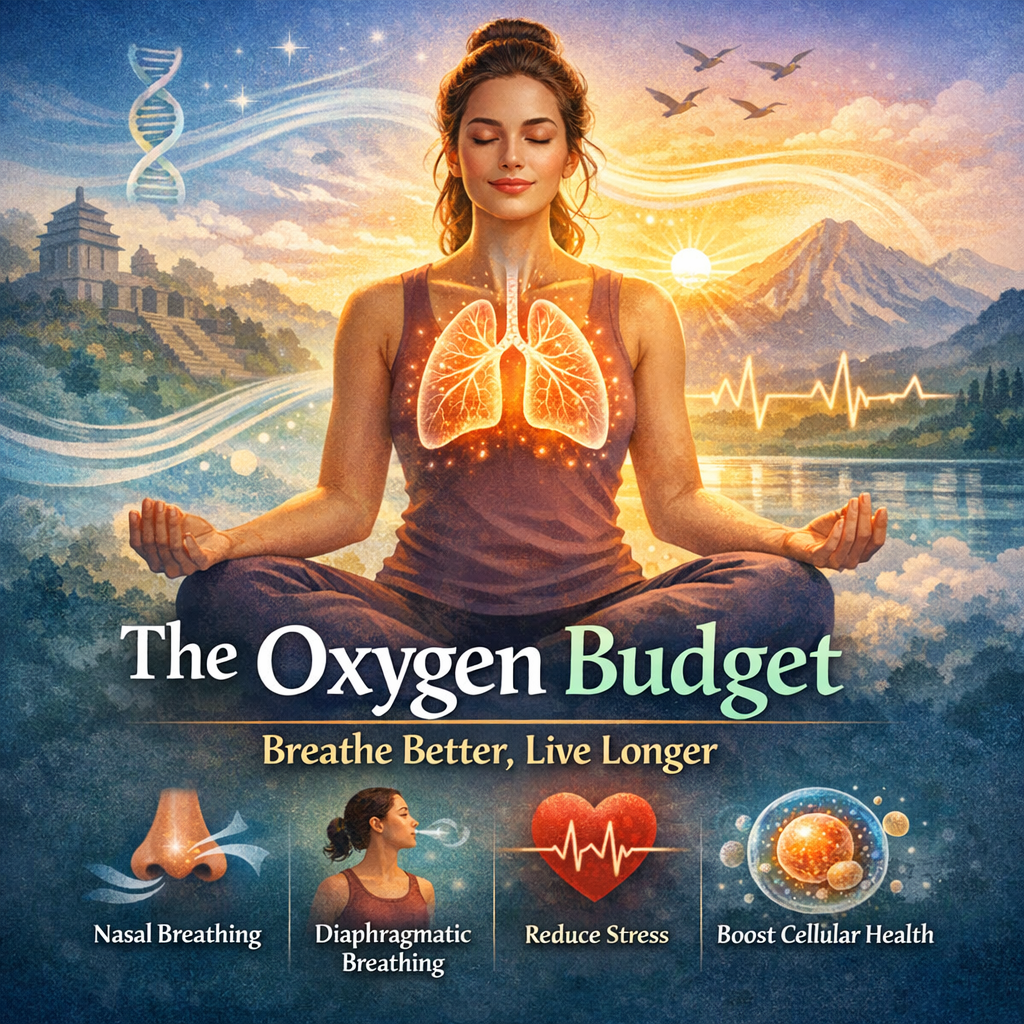
The art of **efficient breathing** can be traced back to ancient practices like **pranayama**, a **yogic discipline** emphasizing control and regulation of breath. Modern science delves deeper, revealing breathing techniques that optimize our oxygen budget. Techniques like **diaphragmatic breathing**, **nasal breathing**, and **controlled breath holding** balance oxygen and carbon dioxide levels, enhance the cardiovascular system’s function, reduce stress, and potentially support better health and longevity.
Lifestyle choices and daily habits can either support or hinder the efficiency of our breathing. **Chronic stress**, pollution, poor posture, and lack of exercise can alter natural breathing patterns, leading to over-breathing or shallow breathing, which may deplete our oxygen budget over time. This depletion might seem insignificant day-to-day but cumulatively can compromise **cellular function** and resilience, potentially accelerating aging.
Features
Research increasingly highlights the pivotal role that **efficient breathing** plays in maintaining health. A landmark study by the **National Center for Biotechnology Information** stressed the importance of understanding the **biochemistry of breathing**, particularly in regulating the balance between **oxygen (O2)** and **carbon dioxide (CO2)** levels, critical for maintaining pH levels in the blood, essential for cellular function and **metabolic processes** [NCBI](https://www.ncbi.nlm.nih.gov/).
Moreover, a study published in the **Journal of Sports Medicine** explored how **controlled breathing** enhances **athletic performance** by improving **oxygen efficiency** and reducing **lactic acid** production in muscles. The findings suggest those who practice controlled breathing methods can optimize their oxygen consumption and increase stamina and endurance, indicators of overall health and longevity [Journal of Sports Medicine](https://journals.sagepub.com/).
Another study involving the **Buteyko Breathing Method**, emphasizing reduced breathing rates to enhance CO2 levels, showed improvements in **respiratory** and **cardiovascular function**. Participants experienced enhanced **autonomic nervous system function**, resulting in lower blood pressure and reduced anxiety levels, conditions often associated with **chronic stress** and accelerated aging [Buteyko Clinic](https://buteykoclinic.com/).
Interestingly, **mindful breathing techniques** extend beyond individual well-being. A cross-sectional study in workplace environments revealed that deep breathing exercises reduced stress and improved emotional health among employees. Such findings underline the potential for breathing practices to improve personal health and enhance productivity and emotional resilience in various settings [Occupational Health Psychology Journal](https://www.apa.org/pubs/journals/ocp).
Conclusion
Managing your **oxygen budget** through efficient breathing marries ancient wisdom with modern scientific discoveries. Focusing on how we breathe can unlock pathways to improved health, stress reduction, and longer, more fulfilling lives. Oxygen, like any other critical resource, must be budgeted wisely to optimize cellular health and longevity. The practice of mindful breathing holds the power to transform health outcomes and extend the human lifespan.
Embracing controlled and conscious breathing not only helps us live longer but also enriches life quality. By integrating breathing exercises into daily routines, we can harness the full potential of the oxygen budget, promoting a healthy circulatory system, balanced emotional states, and enhanced resilience against age-related challenges. As evidence mounts, the call to be aware of and intentional about how we breathe becomes increasingly compelling—not just as a means to an end, but as an invaluable practice toward enduring wellness.
Concise Summary
“The Oxygen Budget” discusses the critical role of managing our breathing to enhance health and prolong life. It highlights the concept of the oxygen budget, emphasizing efficient breathing techniques like diaphragmatic and nasal breathing. These methods align with both ancient practices such as pranayama and modern science. Research shows that optimizing oxygen usage improves cellular health, reduces stress, and boosts athletic performance. The article underlines how lifestyle factors like stress and poor posture can affect breathing and accelerate aging. Ultimately, mindful breathing can enrich life quality and resilience against age-related challenges.

Dominic E. is a passionate filmmaker navigating the exciting intersection of art and science. By day, he delves into the complexities of the human body as a full-time medical writer, meticulously translating intricate medical concepts into accessible and engaging narratives. By night, he explores the boundless realm of cinematic storytelling, crafting narratives that evoke emotion and challenge perspectives.
Film Student and Full-time Medical Writer for ContentVendor.com